
How to Search Lee County Warrants
There is no single public Lee County warrant search portal that lists every active warrant by name. The path most people take is a mix of three checks. Each one shows a piece of the picture. None of them is perfect on its own.
The Lee Clerk MATRIX system is the best public starting point. It holds criminal case dockets for the Twentieth Judicial Circuit, and capias or bench warrant entries appear there when a judge signs them. The Lee County Sheriff Warrants Unit is the second path. The Unit runs 24/7 and is the office of record for active arrest warrants. The third path is a criminal defense attorney, who can pull confidential or sealed records that the public cannot see.
- Open the Lee Clerk MATRIX at matrix.leeclerk.org. Pick the criminal search, type the last name, and run the search. Look in each case docket for entries like "capias issued," "bench warrant," or "warrant for failure to appear."
- Call the Lee County Sheriff Warrants Unit at (239) 477-1272 or email Warrantsgroup@sheriffleefl.org to ask if a named person has an open warrant. The Unit operates around the clock.
- If the warrant is for the searcher, hire a Florida criminal defense lawyer before any in-person contact. Counsel can confirm the warrant, plan a surrender, and ask the court for a bond review.
- Check the Lee Sheriff booking search to see if the person has already been booked on the warrant. A booking entry means the warrant has been served.
Note: Sealed warrants and active investigation warrants will not show up in any public search and can only be confirmed through court or counsel.
Lee County Warrant Search Status
The honest picture is that Lee County does not run a public, browsable warrant list the way some counties do. A check of the Lee County Sheriff site did not turn up a navigable "active warrants" page in the public menu. A backend JSON endpoint exists at sheriffleefl.org/public-api/warrants, but on inspection it returned an empty array. That endpoint is not a search tool the public can use, and no name or date filter on it returned a hit during the check.
So what does that mean in plain words? It means the path to a Lee County warrant check is not one search box. It is a set of steps. The reader should not trust a third-party site that claims to offer a full Lee County warrant list. Those sites pull old data, sell ads, and have no link to the real warrant file.
The records that do show warrant activity in public are the criminal case dockets in MATRIX. When a judge signs a capias, the clerk posts the docket line. The full warrant document itself often stays out of public view. The Sheriff Warrants Unit holds the master list of active arrest warrants and is the right office to call when a yes-or-no answer is needed.
Note: Build copy on this page reflects the public-access picture at the time of writing; the Sheriff or Clerk may add a new public warrant page later, so a fresh check of sheriffleefl.org and leeclerk.org is a good idea each time.
Types of Warrants in Lee County
Lee County courts and the Sheriff handle a few core warrant types. Each one comes from a different rule, serves a different end, and shows up in a different place. The table below sums up the common ones.
| Type | What It Authorizes | Where It Appears |
|---|---|---|
| Arrest warrant | Arrest of a named person on probable cause for a charge. | Sheriff Warrants Unit master file; MATRIX criminal docket when filed in court. |
| Bench warrant or capias | Arrest for failure to appear, contempt, or breach of a court order. | MATRIX criminal case docket entries; Sheriff service file. |
| Search warrant | Search and seizure at a stated place or for stated items. | Often sealed during the investigation; later in court file. |
| Violation warrant | Arrest for a probation or community-control violation. | MATRIX criminal docket; Department of Corrections file. |
| Child support contempt writ | Civil contempt arrest for missed support payments or hearings. | MATRIX family or civil docket; Sheriff civil service. |
An arrest warrant and a bench warrant are not the same thing, even though both can lead to a jail booking. A search warrant is about a place or property, not about a person. A violation warrant flows from a prior court case and counts the old judgment as part of its base.
Arrest Warrant vs Search Warrant
The two warrant types people most often mix up are the arrest warrant and the search warrant. They serve different aims and rest on different statutes. The table sets the lines side by side.
| Trait | Arrest Warrant | Search Warrant |
|---|---|---|
| Main purpose | Take a named person into custody. | Search a place or seize property or data. |
| Statute | Florida Statutes § 901.02 | Florida Statutes § 933.07 |
| What it authorizes | Arrest of the person and booking into the jail system. | Entry, search, and seizure under stated limits on the warrant. |
| Who issues it | A judge of the Circuit or County Court, on probable cause from a sworn complaint. | A judge, on probable cause sworn by an officer or investigator. |
| Public access | Often public once filed; some stay sealed until served. | Often sealed during the investigation; may stay limited later. |
A Lee County arrest warrant is the order that lets a deputy take a person into custody and book them at the Downtown Jail. A search warrant lets law enforcement enter a home, vehicle, or device and pull stated items as proof. Both must rest on sworn probable cause; both are signed by a judge.
Bench Warrant and Capias in Lee County
A bench warrant is one a judge signs from the bench. The most common cause is failure to appear at a set court date. A capias is the Latin term Florida courts use for the same kind of order. In Lee County criminal cases, "capias issued" is the docket phrase that flags this.
Bench warrants and capias orders show up on the MATRIX criminal case docket as one-line entries. A clerk types the line when the judge signs the order. The clerk does not post the full warrant page in most cases. But the docket line is enough to know that a warrant is open and that the person should act fast.
The fix for a Lee County bench warrant is almost always the same. The person must come back to court, often with counsel. The judge may withdraw the warrant once the missed step is cured, or may set a new court date and bond. Some bench warrants are no-bond, which means no bail until a judge holds a hearing.
The Lee Clerk site directs court date alerts through eNotify. Signing up for eNotify on a pending case is one way to avoid the missed-date trap that creates a bench warrant in the first place.
How to Check for a Lee County Warrant Through Court Records
The Lee Clerk MATRIX system is the most useful public path for a warrant check that touches a court case. It is free to use and does not require an account for basic public search. The system is the public face of the Twentieth Judicial Circuit court file for Lee County.
MATRIX shows criminal, civil, family, and traffic case dockets. For a warrant check, the criminal search is the one to use. The clerk posts case events as they happen, and warrant events ride on the docket as short text lines. Common phrases to look for include "capias issued," "bench warrant," "warrant for failure to appear," "alias capias," and "violation of probation warrant."
The rule behind a Lee County arrest warrant is Florida Statutes § 901.02. The statute says a judge may issue an arrest warrant on a sworn complaint that states facts amounting to probable cause. The warrant lists the name of the person, the offense, and the order to bring the person before the court. When a judge signs that order in a Lee County case, the clerk logs it in MATRIX.
Two notes help when the MATRIX search comes back empty. First, sealed and juvenile cases do not show full results in the public view. Second, the clerk uses a wildcard search style, so a last-name-only run needs an asterisk in the First Name box.
How to Resolve an Outstanding Warrant in Lee County
An outstanding Lee County warrant does not fix itself. The longer it sits, the worse the position. A traffic stop, a job background check, or a routine ID run can flag it. The steps below set a safe, simple path. Counsel should run the show on each step.
- Verify the warrant. Call the Sheriff Warrants Unit, search MATRIX, or ask a lawyer to confirm. Do not act on a rumor or a third-party site.
- Retain counsel. A Florida criminal defense lawyer can pull the sealed details, set up a surrender, and ask for a bond. People who qualify can ask the court to appoint the Twentieth Circuit Public Defender at first appearance.
- Plan a court date. For a bench warrant, the lawyer can file a motion to recall the warrant and set the case for hearing. The court may strike the warrant on its own or hold a status check.
- Coordinate surrender. If a surrender is needed, the lawyer and the Sheriff Warrants Unit work out the time and place. Bring valid photo ID. Expect booking at the Downtown Jail intake at 2115 Martin Luther King Boulevard, Fort Myers.
- Post bond if granted. Bond depends on the charge and any prior history. Some bench warrants are no-bond until a judge reviews. Counsel can ask for a bond hearing at first appearance.
- Follow the case. After release, log onto MATRIX or sign up for eNotify alerts. Missing the next court date can trigger a new capias right away.
Note: Do not turn yourself in without legal advice, since the bond and the timing can change the case for months to come.
Sheriff Warrants Unit and Civil Unit Contacts
The Lee County Sheriff's Office is the agency of record for warrant service in Lee County. The main office sits at 14750 Six Mile Cypress Parkway in Fort Myers. The Warrants Unit is open 24/7 because warrants come in at all hours and need fast action. The Civil Unit handles civil process such as subpoenas, summons, and writs.
The lead-in to the warrant photo below is on Florida Statutes § 901.02, the statute that controls arrest warrants in the state. The image shows the official Florida Senate page for that section.
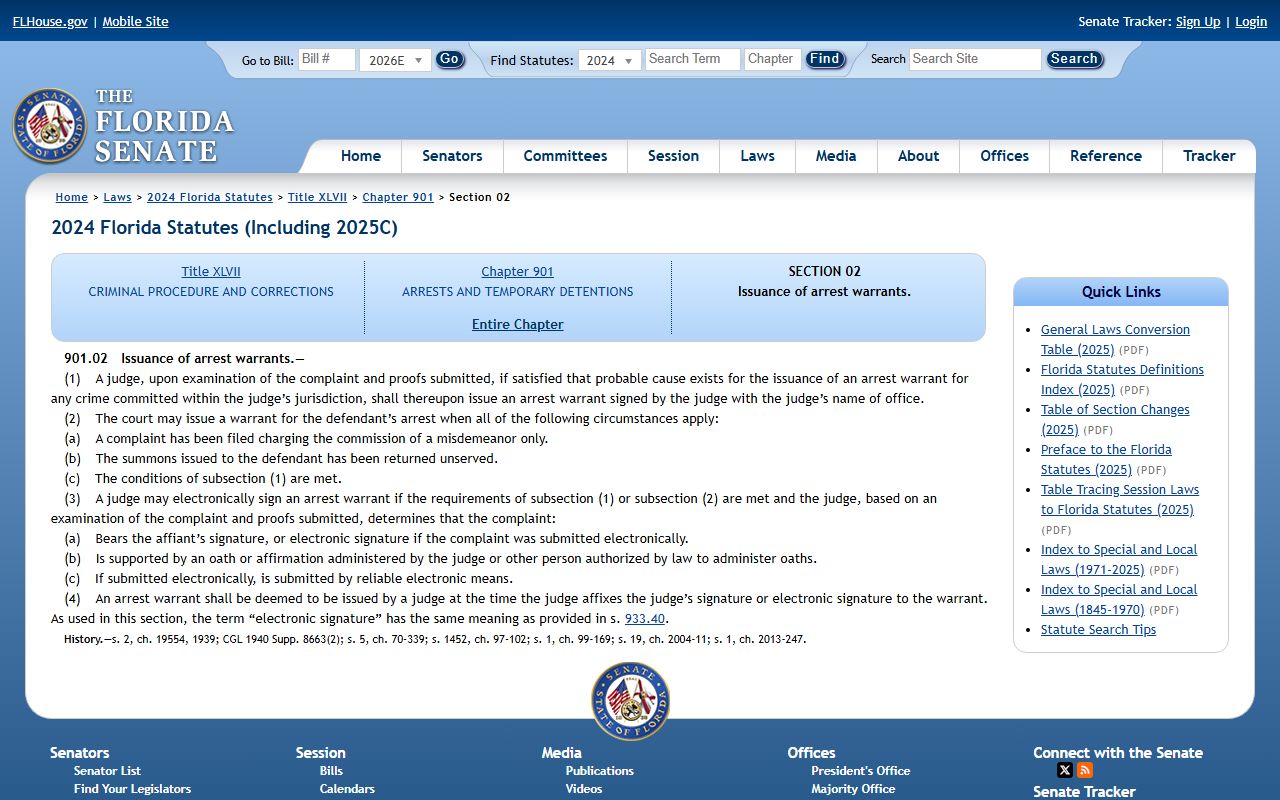
The statute text on that page sets the rule a Lee County judge follows when an officer asks for a warrant. The contact card below sets out the lines to use when a Lee County warrant question comes up.
Lee County Sheriff Warrants Unit
Phone: (239) 477-1272
Fax: (239) 477-1269
Email: Warrantsgroup@sheriffleefl.org
Hours: 24 hours, 7 days
Lee County Sheriff Civil Unit
Phone: (239) 477-1353
Lee County Sheriff (non-emergency)
Phone: (239) 477-1000
Web: sheriffleefl.org
Warrant Scams in Lee County
Lee County has seen a steady run of warrant-based phone scams. The Sheriff has put out warnings about the same script played in many homes. A caller claims to be a deputy or court officer. The caller says a Lee County warrant is open in the name of the person or a family member. The caller then demands gift cards, crypto ATM payments, or wire transfers to clear the warrant or set up an ankle monitor.
Scam warning. No real Lee County deputy or court clerk will call to collect cash, gift cards, or crypto to clear a warrant. Hang up. Call the Lee County Sheriff Warrants Unit at (239) 477-1272 to verify any claim.
Scammers use the public arrest data on the Sheriff site to pick fresh names. They call the family of a person just booked, claim a bond payment is owed, and push for a gift card on the spot. The pressure is fast on purpose. Real warrant resolution runs through the court, not a cash app.
A second twist uses fake court hearing notices. The caller says the person missed jury duty or a court date, and a Lee County bench warrant is open. The caller wants a payment to "clear the warrant." Real jury duty and court date issues run through the Lee Clerk and the court, never through a phone payment.
Statutes Behind Lee County Warrants
Two Florida statutes set most of the warrant rules a Lee County court uses. Arrest warrants flow from § 901.02. Search warrants flow from § 933.07. Bench warrants and capias orders are tools the court holds under its own rules and case law, but they ride on the same probable-cause and due-process base.
Statute callout. Lee County warrant practice rests on Florida Statutes § 901.02 (arrest warrants) and Florida Statutes § 933.07 (search warrants). Both require a judge to find probable cause before signing.
Section 901.02 sets the form and content rules. The warrant must name or describe the person, state the offense, and order the officer to bring the person before the court. Section 933.07 covers the issuance of search warrants when probable cause supports the search.
Read the source page for § 933.07 to see the full text and the cross-references the Florida Legislature lists.
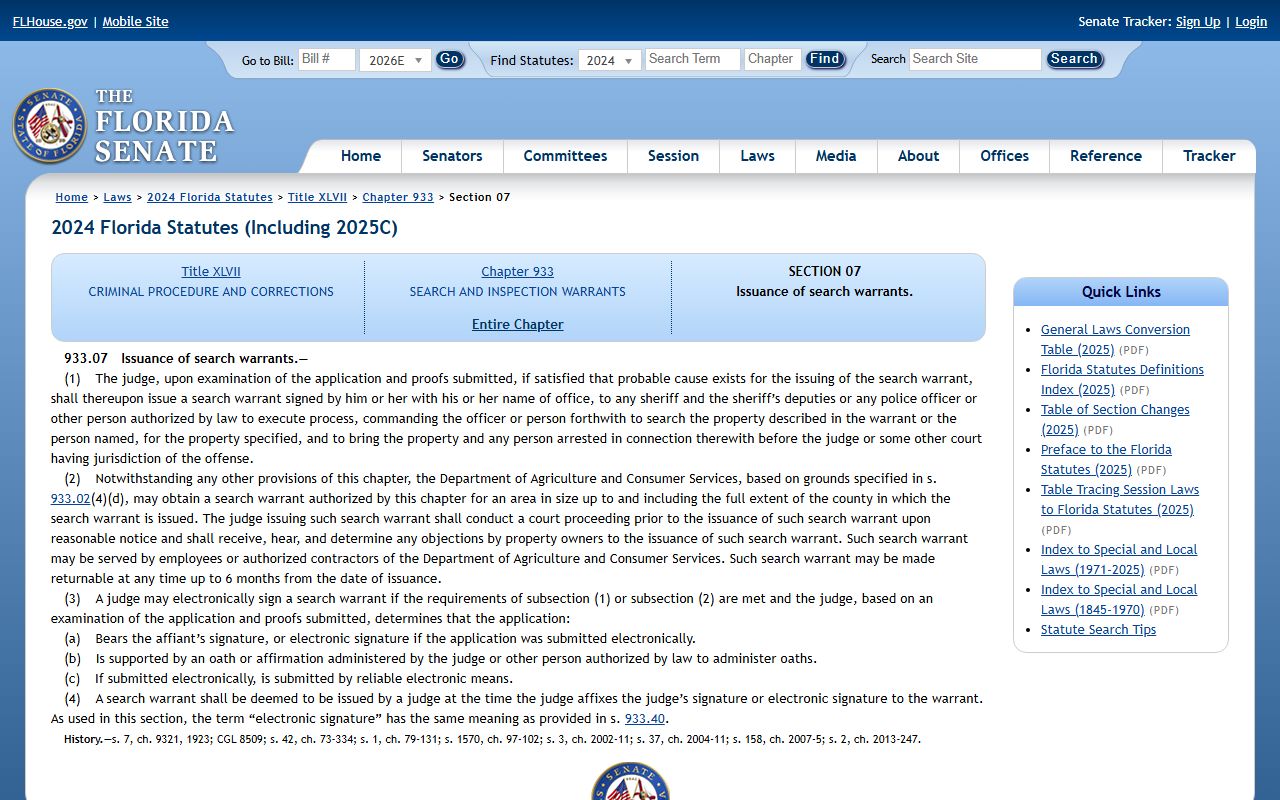
The text confirms the rule that a Lee County search warrant must rest on sworn facts in front of a judge. A defense lawyer can move to suppress the search if the warrant did not meet the § 933.07 base.
Both statutes link up with Florida Rule of General Practice and Judicial Administration 2.420, which sets when court files become public and when they stay sealed. That rule is the reason some Lee County warrant pages do not show up in MATRIX until after the warrant is served.
Common Questions
Two of the most common Lee County warrant questions come up below. The full FAQ list with more topics sits on the FAQ page.
Q: Can I find out if I have a Lee County warrant online without calling anyone?
A: Maybe, but not in full. The Lee Clerk MATRIX system shows criminal case dockets, and a capias or bench warrant entry will read on the docket. A direct public list of all active Lee County warrants is not on the Sheriff site. For a yes-or-no answer, call the Sheriff Warrants Unit or ask a defense lawyer to check.
Q: Will a Lee County warrant show up on a background check?
A: Yes, in most cases. Active arrest warrants and pending criminal cases tied to a warrant show up on Florida court record searches and most paid background checks. Sealed warrants and some search warrants do not show. An outstanding warrant can also block a job offer, a gun purchase, or a state license. See the criminal records page for more on how Lee County records flow into background checks.