
How to Search Lee County Traffic Court Records
Most Lee County traffic court records sit in one place. The Clerk of Court runs MATRIX, the public case search at matrix.leeclerk.org. MATRIX shows open and closed cases, hearing dates, dockets, fines, and payment status. The Clerk's Traffic and Ordinance page explains the deadlines and the basic options after a ticket is issued. Civil traffic and parking ticket files have one quirk worth noting. The Clerk removes images from the public site after the case closes, the file is final, all fines are paid, and the docket meets the 14-month or 426-day retention window under Florida Rule of General Practice and Judicial Administration 2.430. The case summary and progress docket can still be pulled on request.
A few pieces of info make the search faster. The citation number works best. The case number works once the ticket has been booked into a court file. A driver's first and last name also pulls a list. A date range narrows the result count when a name returns too many hits.
- Open MATRIX at matrix.leeclerk.org and accept the public terms.
- Type the citation number in the Citation Number box, or use a first and last name with a date range.
- Check one or more case-type boxes such as Traffic Infraction, CriminalTraffic, Parking Ticket, or Non Criminal Infraction.
- Review the result list. MATRIX caps the list at the first 500 case results and the first 200 hearing results.
- Click the case to view the docket, hearing dates, fines, and payment status, then choose to pay, set a hearing, or request a certified copy.
Which Courts Handle Traffic Cases in Lee County
In Florida, civil traffic infractions and most ordinance citations land in County Court. Criminal traffic charges can go to County Court or Circuit Court based on the offense and the charging decision. DUI starts as a misdemeanor in County Court but moves to Circuit Court if a felony charge applies, such as DUI with serious bodily injury or a third or later offense. The Lee County County Court and Circuit Court both sit in the Twentieth Judicial Circuit. Both feed cases into the same Clerk's case management system, which is why one MATRIX search covers all of them.
The case-type filter is what splits traffic from the rest. MATRIX exposes CriminalTraffic, Traffic Infraction, Non Criminal Infraction, Parking Ticket, County Ordinance, Municipal Ordinance, Misdemeanor, and Appeals. Each maps to a different court division and a different set of rules.
| Case Type | Court Level | Common Examples |
|---|---|---|
| Traffic Infraction | County Court | Speeding, red light, seat belt, careless driving |
| Non Criminal Infraction | County Court | Equipment, registration, license display |
| Parking Ticket | County Court | Meter, fire lane, handicap zone |
| County / Municipal Ordinance | County Court | Local code violations, noise, animal control |
| CriminalTraffic | County or Circuit Court | DUI, driving while license suspended, reckless |
| Misdemeanor | County Court | First or second DUI, leaving scene under threshold |
| Appeals | Circuit Court Appellate | Appeals from County Court traffic rulings |
For a deeper look at the trial courts, see the Circuit Court and County Court pages. Most Lee County traffic case files start and end at the County Court level.
Types of Traffic Cases on Record
Traffic case types are not one thing. Each carries its own fee range, its own point rules, and its own path through the court. The MATRIX list gives the clean break. A short read of each helps.
- Traffic Infraction - Civil moving and non-moving violations. The state calls these noncriminal traffic infractions under Florida Statutes § 318.14. No jail. A fine, points, or both.
- CriminalTraffic - DUI, driving while license suspended with knowledge, reckless driving, leaving the scene. These carry jail risk and a criminal case file.
- Parking Ticket - Meter, fire lane, time limit, handicap zone. No points to the driver record. Often handled by mail or online.
- Non Criminal Infraction - Equipment, registration, faulty light, expired tag. Often dismissable with proof of fix or current paperwork.
- County or Municipal Ordinance - Local code violations from Lee County, Fort Myers, Cape Coral, Bonita Springs, or Sanibel. Some involve a vehicle, some do not.
- Misdemeanor - First and second DUI, drag racing, and other charges that exceed civil traffic but stay below felony level.
- Appeals - Review of a County Court traffic ruling by a Circuit Court appellate panel.
Photo-enforced red light tickets and school zone speed cameras feed the same Traffic Infraction case type when a Notice of Violation becomes a Uniform Traffic Citation. The fine and point treatment shifts at that point.
What Lee County Traffic Court Records Show
A Lee County traffic case file is built around the citation. Once the Sheriff, the Highway Patrol, or a local officer writes the ticket, the Clerk opens a case and adds fields for every step that follows. The fields read like a small history of the ticket, from issue date to final payment or court ruling. The FLHSMV's official Traffic Citations guide sets the basic framework the Clerk applies to each case.
The next image lays out the state's pay or contest framework. Florida Highway Safety and Motor Vehicles publishes the official rule set for any Uniform Traffic Citation issued in Lee County.
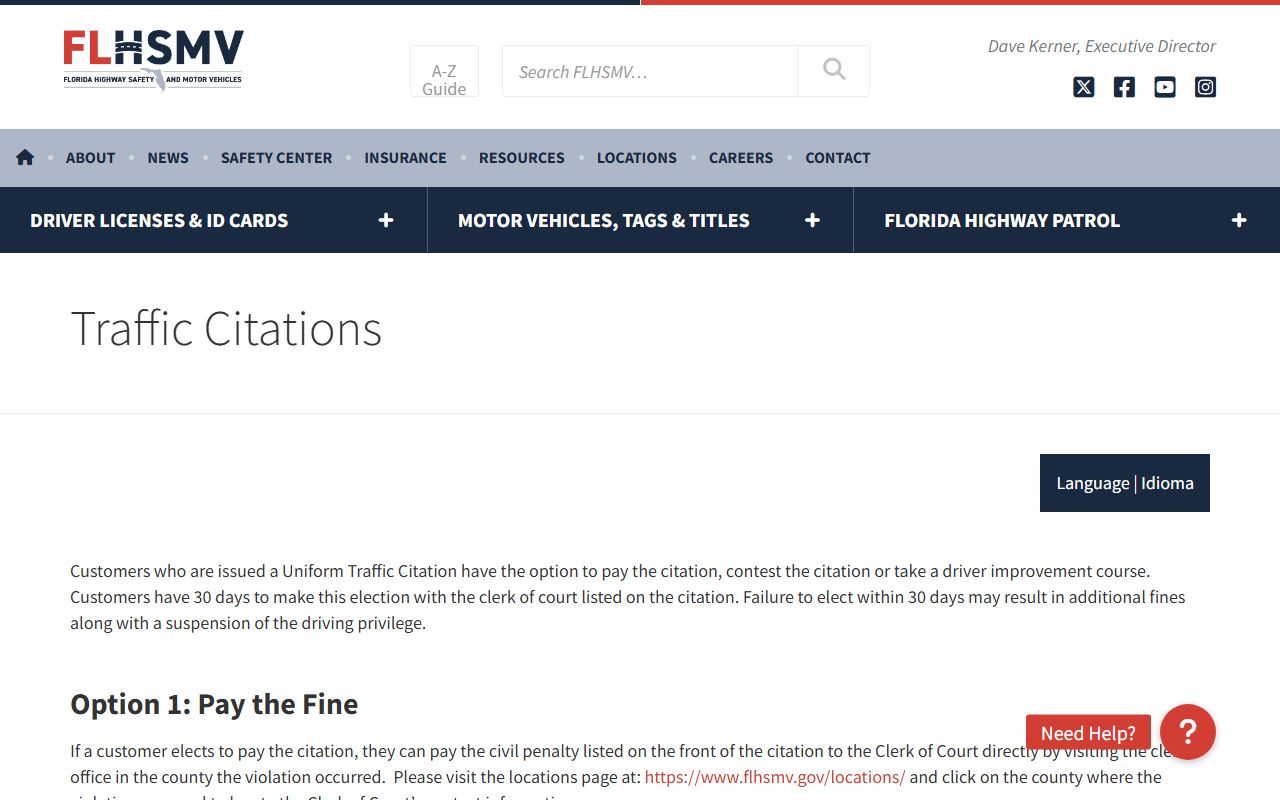
The state framework is the same in every county. Lee Clerk then layers in the local case file fields.
| Field | What It Shows |
|---|---|
| Citation Number | Unique number on the ticket; best search key in MATRIX. |
| Case Number | Court-assigned number once the citation becomes a case. |
| Case Type | Traffic Infraction, CriminalTraffic, Parking Ticket, Non Criminal Infraction. |
| Defendant / Driver Name | Name on the citation as written by the issuing officer. |
| Filing / Issue Date | Date the officer wrote the ticket and the date the Clerk filed it. |
| Court Location and Division | Justice Center, Cape Coral branch, or the relevant County Court division. |
| Hearing Date / Time | Set when the driver contests the ticket or when court is required. |
| Charge / Violation | Plain-language description of the offense. |
| Statute / Ordinance | Florida Statute or local code section cited. |
| Disposition / Election | Paid, school elected, no contest, dismissed, adjudicated, or convicted. |
| Fine / Cost Amount | Base fine plus any court costs and surcharges. |
| Payment Status | Open, paid in full, payment plan, or sent to collections. |
| Compliance Proof | License, registration, insurance, or school affidavit on file. |
| Suspension / Clearance | Driver license suspension or clearance flag where shown. |
| Docket Entries | All filings and orders in date order. |
Searching by Citation Number vs by Name
Each search field has a best use. The citation number is the cleanest path. It maps to one case. The case number works once a ticket converts. A name search is the fallback when the paper ticket is lost. Common names return long lists, so a date range or a date of birth helps trim the result count.
MATRIX hover tips show the field format. The system caps the result list at the first 500 cases. A name search that returns a full 500 hits often needs to be re-run with a date range.
| Search Field | Type | Required | Notes / Format |
|---|---|---|---|
| Citation Number | Text | Optional | Best field when the paper ticket is in hand. |
| Case Number | Text | Optional | Use after the citation has been booked into a court case. |
| First / Last Name | Text | Optional | Wildcard support; pair with a date range for better hits. |
| Date From / Date To | Date | Optional | MM/DD/YYYY; narrows by file date or hearing date. |
| Case Type | Checkbox | Optional | CriminalTraffic, Traffic Infraction, Parking Ticket, Non Criminal Infraction. |
| View Court Calendar | Checkbox | Optional | Use for a hearing-date search rather than a case search. |
Note: A citation issued today may take a few business days to show up in MATRIX, since the Clerk has to load the citation into the case management system before it can be found.
Paying or Contesting a Lee County Traffic Ticket
The Clerk gives drivers four ways to pay a Lee County traffic ticket. Each has its own fee or service charge. The election deadline is 30 days from the date the citation is issued. A driver who misses that 30-day window can pick up extra fees and a possible driver license suspension. After 90 days, the Clerk can send the unpaid citation to a collection agency, which adds a 25% fee to the balance.
A driver can pay the ticket, pay and elect a basic driver improvement course, plead no contest with or without a hearing, or set a court date to contest. Paying the civil penalty counts as a conviction and may add points to the driver record. Contesting routes the ticket to a court hearing where the State has to prove the violation.
| Method | Detail | Service Fee |
|---|---|---|
| Online | nCourt portal linked from the Clerk site | 5% |
| Phone | (239) 271-3252 | 6% |
| P.O. Box 2507, Fort Myers, FL 33902 | None | |
| Overnight | 1700 Monroe Street, Fort Myers, FL | None |
| In person (Fort Myers) | Justice Center, 2075 Dr. Martin Luther King Jr. Blvd, 1st Floor | None |
| In person (Cape Coral) | Cape Coral Government Complex, 1039 SE 9th Place, 2nd Floor | None |
If proof of compliance is needed, the Clerk accepts a copy of the driver license, the registration, the insurance card, a proof of compliance affidavit, or a traffic school affidavit. Send the proof to courts@leeclerk.org or mail it before or with the payment. A citation paid online may take up to seven days after issuance to show up in nCourt.
- Read the citation and note the issue date, citation number, and the Clerk listed.
- Decide within 30 days whether to pay, elect school, plead no contest, or set a hearing.
- If paying online, wait up to seven days, then pull the citation in nCourt.
- If proof of compliance is needed, send it to courts@leeclerk.org or mail it with the payment.
- If contesting, contact the County Court for a hearing date and bring evidence to court.
- If electing traffic school, confirm eligibility, pay the fee, complete an approved course, and check that completion was reported.
- Verify the driver license status after the case closes if any deadline was missed.
Public Access Laws for Traffic Court Records
Lee County traffic court records are public under Florida's broad open-records framework. Chapter 119 governs agency records. Rule 2.420 of the Florida Rules of General Practice and Judicial Administration governs court files. Together, they make most traffic citations and case dockets open to public inspection. Some fields, like a driver license number or a home address, can be redacted under Florida Statutes § 119.0714.
The Florida Senate hosts the official statute that sets the procedure for any noncriminal traffic infraction filed in Lee County. The image below shows the official source.
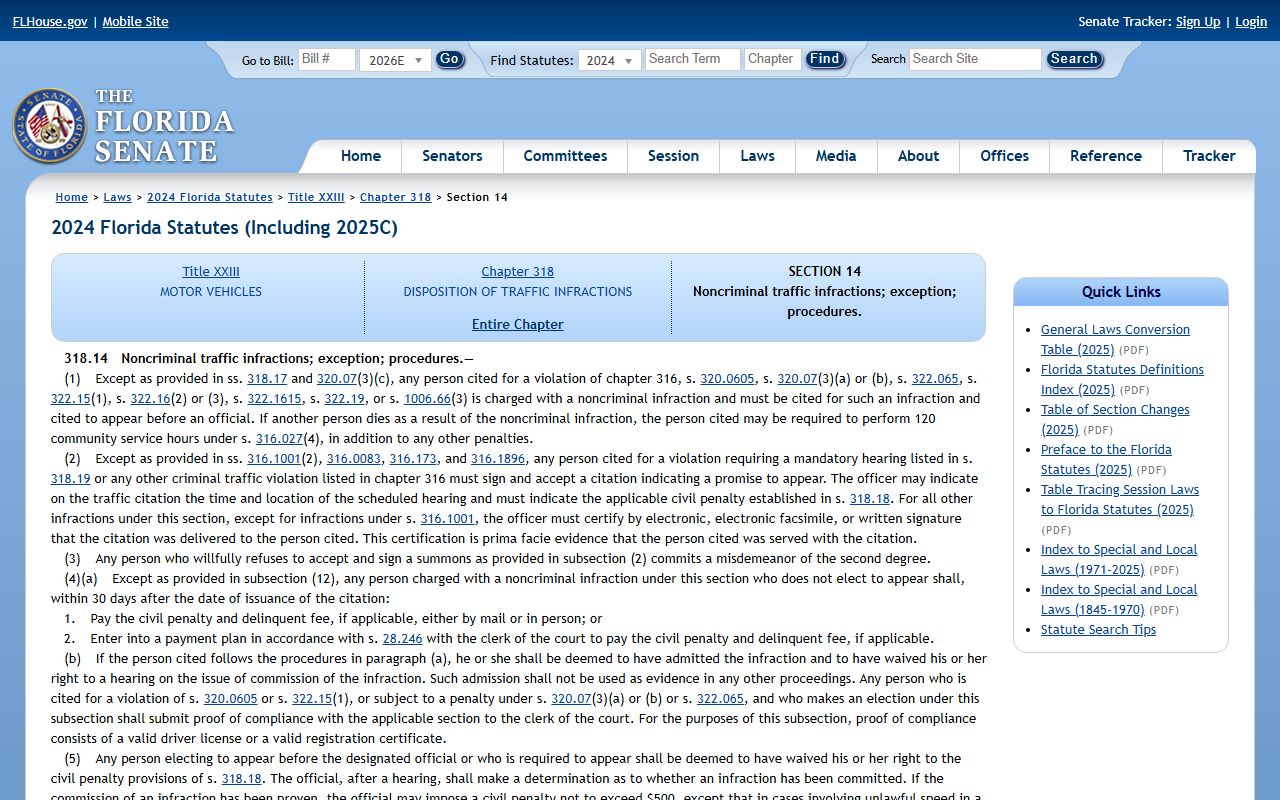
That statute sets the 30-day clock, the election options, and the hearing path. The companion statutes cover the driver improvement course rules and the license point system.
Key Statutes for Lee County Traffic Records:
- Florida Statutes § 318.14: noncriminal traffic infraction procedures, election options, and hearing process.
- Florida Statutes § 318.1451: driver improvement schools and course-provider reporting to the Clerk of the Circuit Court.
- Florida Statutes § 322.27: driver license authority for points, suspensions, and revocations.
- Florida Statutes § 119.0714: court files, court records, and limits on sensitive identifiers.
- Rule 2.430: retention and destruction of court records, including civil traffic and parking infractions.
Court Traffic Record vs State Driver Record
One ticket lives in two places. The court case file sits with the Lee Clerk. The driver record sits with the Florida Department of Highway Safety and Motor Vehicles. They are not the same file, and they answer different questions. A case file shows the docket for the citation. A driver record shows the lifetime list of convictions, points, and license status for a person. A correction on one does not always change the other.
Insurers, employers, and CDL holders care about the FLHSMV driver record. A judge and a defense lawyer care about the court file. A common Lee County mistake is to assume a paid online citation has been wiped from the driver record. It has not. The conviction posts to the state record under § 322.27 and points apply.
| Factor | Court Traffic Record | State Driver Record |
|---|---|---|
| Maintained By | Lee County Clerk of Court | Florida Highway Safety and Motor Vehicles |
| What It Shows | Citation, docket, fines, hearings, disposition for one case | Lifetime convictions, points, license status, suspensions |
| Where to Access | MATRIX at matrix.leeclerk.org | FLHSMV Online Driver License Check and Form 90511 |
| How to Correct an Error | Motion to the County Court that ruled on the case | FLHSMV review; sometimes needs the court order first |
CDL and Commercial Driver Records
Commercial driver license holders play by a stricter set of rules. Federal law and Florida law bar a CDL holder from masking a moving violation with a withhold of adjudication. That means most civil traffic infractions for a CDL driver post as convictions even when a regular driver could keep points off the record. Some CDL drivers also have to appear in court in person, since some violations require a mandatory court date.
The driver record carries extra weight for a CDL. A DUI conviction, even in a personal car, disqualifies a CDL for at least one year on the first offense and for life on a second. FLHSMV is the file of record. The federal Driver Privacy Protection Act limits release of personal driver information, but driving violations, license status, and date of birth can still be released within the rules.
A CDL driver who picks up a Lee County citation should pull both the court file in MATRIX and the FLHSMV driver record. The two together show the full picture an employer or the federal Clearinghouse will see.
DUI and DWI Cases
Florida uses DUI, not DWI. A Lee County DUI starts as a misdemeanor in County Court and can move to Circuit Court when a felony charge applies. The case shows in MATRIX as CriminalTraffic or Misdemeanor depending on the level. A DUI conviction adds points, triggers a license suspension, and routes the driver through an FLHSMV-approved DUI school.
For the full DUI case workflow, the booking record, and the post-conviction steps, see Lee County criminal records. The traffic case page is where the civil and non-criminal side lives.
Deferred Adjudication and Defensive Driving
Florida calls it a basic driver improvement course, or BDI. The course is the closest thing to deferred adjudication for a civil traffic ticket. A driver who elects school within the 30-day window can get an 18% reduction in the citation fee and can ask the court to withhold adjudication so points do not post to the driver record. The course runs four hours. Several state-approved providers run it online, by mail, and in person. Florida Statutes § 318.1451 sets the rules and requires the course provider to report completion through the Florida Courts E-Filing Portal within three days of the unique course completion certificate number.
Some violations force a course on top of the fine. Passing a school bus, racing, reckless driving, running a red light, or running a traffic control device all carry a mandatory driver improvement course as part of the conviction. The FLHSMV points and suspensions page sets out the rules.
The next image shows the FLHSMV breakdown of common point values and the suspension thresholds tied to point totals over time.
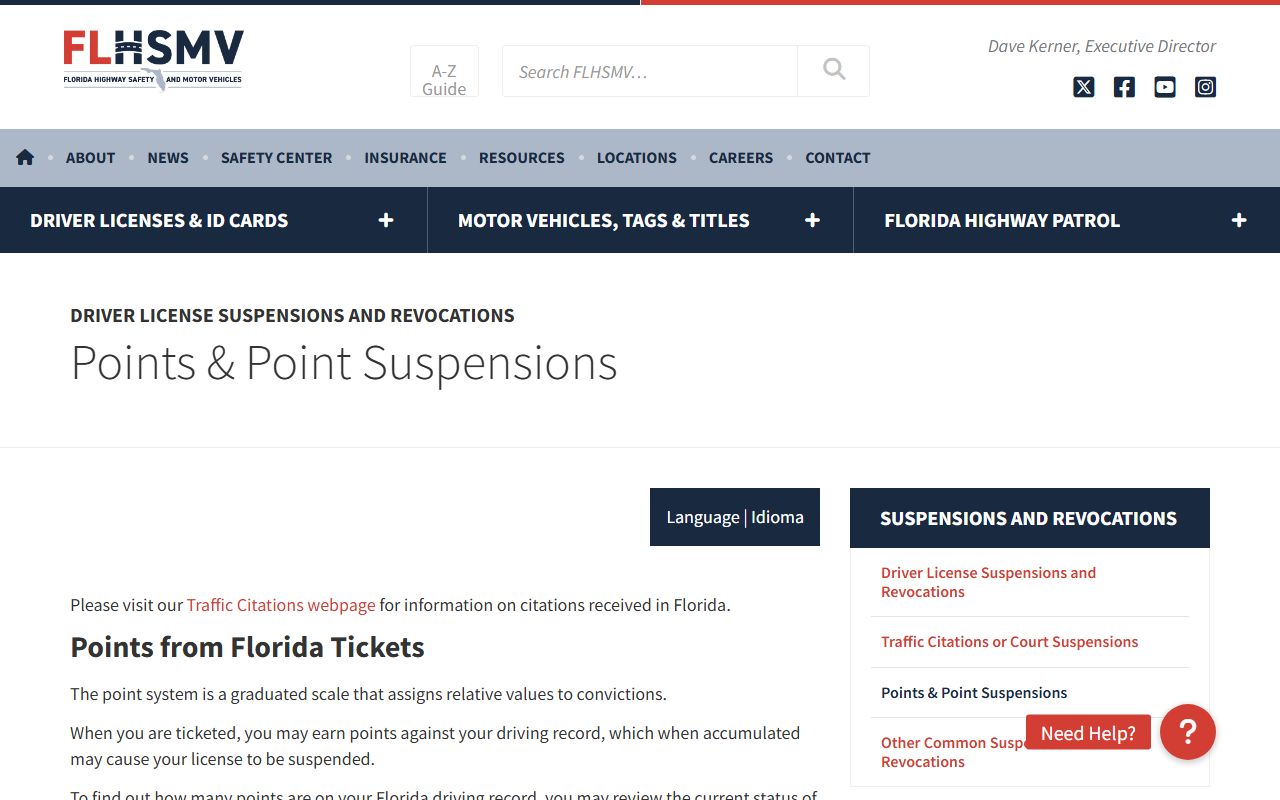
Common point examples come straight from the state. A few highlights:
| Violation | Points |
|---|---|
| Reckless driving | 4 |
| Careless driving | 3 |
| Speeding (general) | 3 |
| Speeding more than 50 mph over limit (listed statutes) | 4 |
| Leaving scene of crash, property damage over $50 | 6 |
| Failure to leave info after unattended-vehicle crash | 6 |
Sealing or Expunging Traffic Records
Civil traffic infractions in Florida are not eligible for sealing or expungement under the standard FDLE process. The court file sits open as a public record, even after the fine is paid. Criminal traffic charges that end in a dismissal, an acquittal, or a withhold of adjudication can qualify under Florida Statutes § 943.0585 for expungement and § 943.059 for sealing. The Florida Department of Law Enforcement issues the eligibility certificate that the court needs before it can grant the petition.
The same image-removal rule helps a closed civil traffic case. Once the file meets the Rule 2.430 retention window, the Clerk removes the document images from the public MATRIX site. The case summary stays available on request. For the full criminal sealing or expungement walkthrough, see Lee County criminal records.
Lee County Traffic Fee Schedule
Lee Clerk posts a public fee schedule for traffic citations and court records. The amounts cover the most common Lee County moving and non-moving violations. Case facts can shift the total, and court costs and surcharges can add to the base fine. Verify the exact balance on MATRIX or call the Clerk.
| Violation or Fee | Amount |
|---|---|
| Moving infractions, non-speeding | $161.00 |
| Non-moving infractions / seat belt violations | $111.00 |
| Pedestrian or bicycle violations | $59.50 |
| Red light violations | $259.00 |
| Speeding 6-9 mph over limit | $126.00 |
| Speeding 10-14 mph over limit | $201.00 |
| Speeding 15-19 mph over limit | $251.00 |
| Speeding 20-29 mph over limit | $276.00 |
| Speeding 30+ mph over limit | Mandatory court |
| School / construction zone 1-9 mph over limit | $151.00 |
| School / construction zone 10-14 mph over limit | $301.00 |
| Failure to stop for school bus | $366.00 |
| Driving History Record (Full) | $16.25 |
| Payment plan setup fee | $25.00 |
Note: Online payments add a 5% nCourt service fee and phone payments add a 6% fee, so the screen total may be higher than the table fine.