
How to Search Lee County Court Records
The main tool is the Lee County Clerk Court Records Inquiry, known as MATRIX or CRI. The portal lives at matrix.leeclerk.org. The Clerk runs it under Florida Supreme Court Administrative Order AOSC 18-16 and the Access Security Matrix. The search is free. It works on phones, tablets, and laptops. It is open 24 hours a day. Case results cap at the first 500 hits. Hearing searches cap at the first 200. Date fields must be typed as MM/DD/YYYY. You can use an asterisk as a wildcard at the end of a name to catch spelling variations.
Before you start, gather what you know. A case number is best. A citation number works for traffic. If you only have a name, plan to use the last name plus a first-name wildcard. Some case types, like family, probate, juvenile, and mental health, will not return full results for the general public. You may need to register a free account or apply for party access to see those documents.
- Open matrix.leeclerk.org and pick the Records Search tab.
- Check one or more case types from the list, or use Check All to start broad and narrow later.
- Type a party name, case number, or citation number. To search by last name only, put an asterisk in First Name and the last name in Last Name.
- Set a date range using MM/DD/YYYY in Date From and Date To if you want to limit the hits.
- Click Search. Review the results list, then click a case to see the docket and any non-confidential documents.
- If a paper is marked Viewable on Request, submit a VOR. The Clerk will review it for confidential or exempt content before releasing the file.
- Buy an e-certified copy through the portal if you need a stamped version. The cost is $8.00 per court document.
For recorded papers like deeds, mortgages, liens, and marriage records, use the separate Lee County Official Records Search at or.leeclerk.org/LandMarkWeb. That site covers the Clerk's role as county recorder, not court dockets.
The MATRIX search form exposes the fields shown below. Hover any field name in the live portal to read the Clerk's field tip.
| Field | Type | Notes |
|---|---|---|
| View Court Calendar | Checkbox | Switches to hearing search; default range is today through one year ahead. |
| Case Types | Checkbox group | Felony, Circuit Civil, County Civil, Domestic Relations, Probate, Traffic, and more. Check All is available. |
| First Name | Text | Use an asterisk in this field when searching last name only. |
| Last Name | Text | Wildcard with an asterisk at the end catches partial spellings. |
| Case Number | Text | Best field when known. Lee County case numbers often look like 26MM022093. |
| Citation Number | Text | Use for traffic or parking tickets. |
| Date From / To | Date text | MM/DD/YYYY format. |
The Lee County Judicial System
Florida runs a two-tier trial court setup. Lee County sits in the Twentieth Judicial Circuit. The circuit also covers Charlotte, Collier, Glades, and Hendry counties. The Circuit Court handles the bigger matters: felonies, family law, probate, guardianship, mental health, juvenile cases, injunctions, real-property title fights, and civil suits over the County Court threshold. The County Court takes misdemeanors, traffic infractions, ordinance cases, small claims, and lower-value civil suits. Both trial courts feed the same Clerk case file, which is why one MATRIX search can pull cases from either court.
The Lee County Justice Center holds the courtrooms, clerk counters, and court administration. Lee County visitors see the official Twentieth Judicial Circuit page at ca.cjis20.org for hours, parking, and security rules. The page lists multiple entrances and includes courthouse photos that show the layout of the complex.
The official Twentieth Judicial Circuit page shows the Lee County Justice Center entrance with parking and security details captured by the circuit itself at ca.cjis20.org.
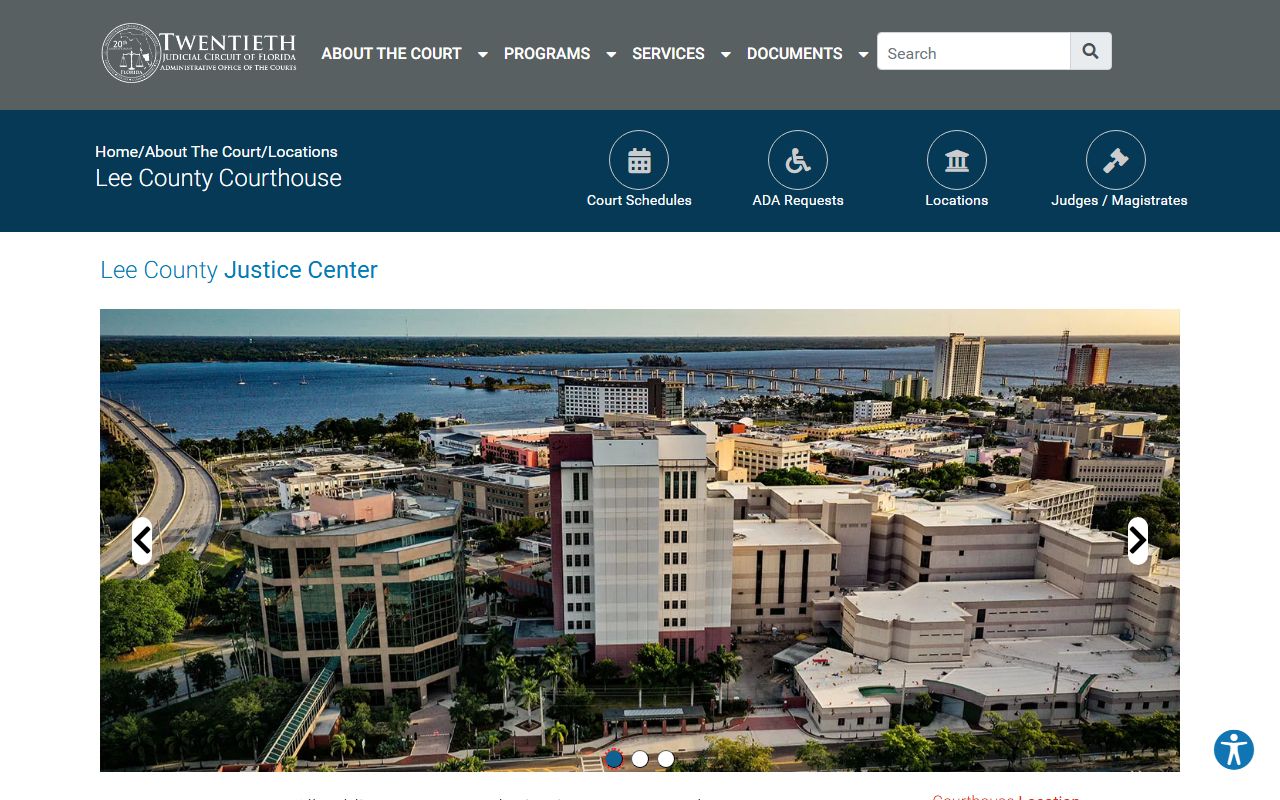
That page is the place to confirm public entrance times and security restrictions before you go.
Case flow: County Court › Circuit Court › District Court of Appeal › Supreme Court of Florida
Appeals from County Court go to the Circuit Court sitting in its appellate role. Appeals from the Circuit Court head to a District Court of Appeal. The Supreme Court of Florida reviews some matters on its own, but most cases end at the DCA.
| Court | Role | Case Types |
|---|---|---|
| Supreme Court of Florida | Highest state court; seven justices in Tallahassee | Death sentences, certain DCA reviews, rule changes |
| District Court of Appeal | Intermediate appeals court | Most appeals from circuit and county trial courts |
| Circuit Court (20th Circuit) | General-jurisdiction trial court | Felony, family, probate, guardianship, juvenile, civil over $50,000 |
| County Court | Limited-jurisdiction trial court | Misdemeanors, traffic, small claims, ordinance, lower-value civil |
The Florida courts landing page at flcourts.gov lays out this hierarchy in plain terms.
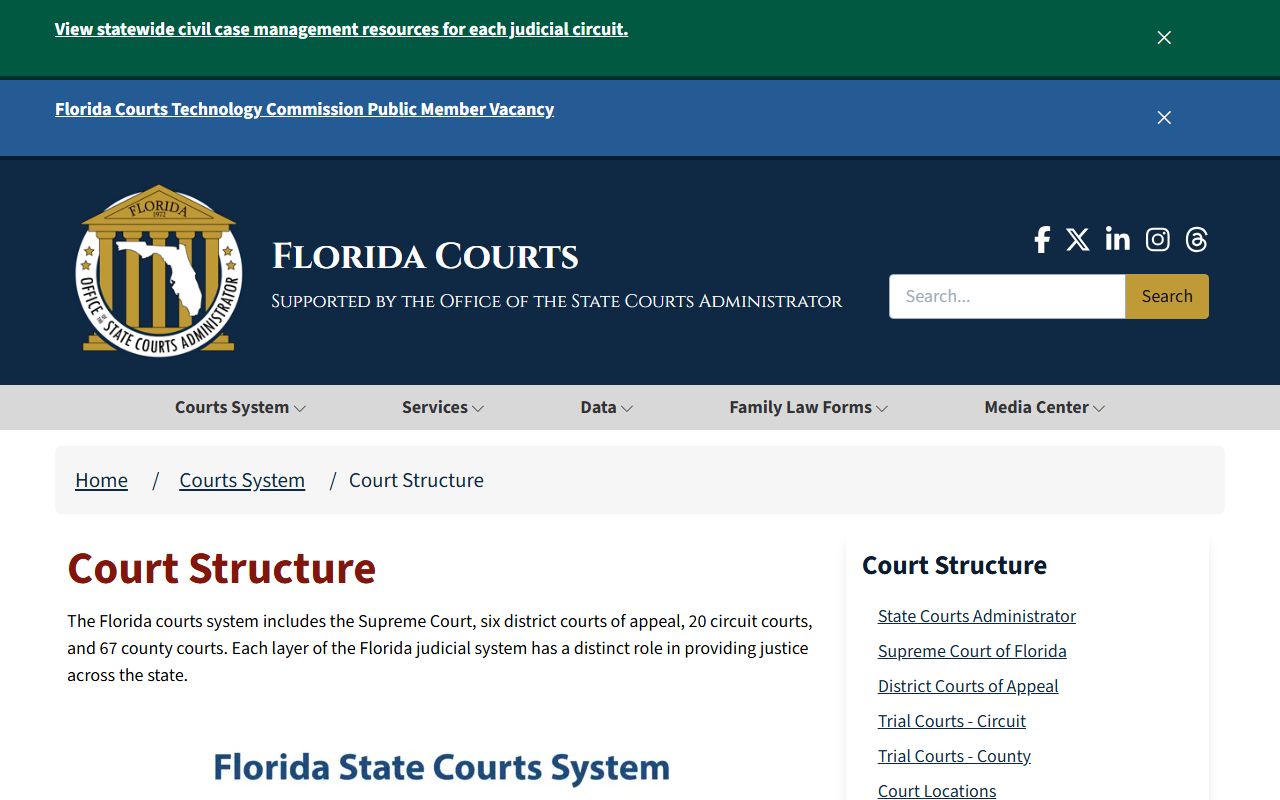
That state page is a good check when you want to know which court hears a given case type.
Types of Court Records Available in Lee County
MATRIX groups Lee County cases by case type. The case-type checkbox list on the search form maps to the Clerk's internal categories. Most types are open to the public at the docket level. Some types limit document views to registered users or parties.
The list below pulls straight from the MATRIX filter set and the Clerk's classification scheme.
- Adult Felony, Misdemeanor, and CriminalTraffic - criminal cases from arrest through plea, trial, sentence, or appeal.
- Circuit Civil and County Civil - civil suits over and under the county-court limit, including evictions, foreclosures, and replevin.
- Domestic Relations - divorce, paternity, custody, child support, and injunctions for protection.
- Probate and Guardianship - estates, formal and summary administration, guardian appointments, and trust matters.
- Juvenile Delinquency and Juvenile Dependency - youth cases; access is sharply limited by statute.
- Mental Health - Baker Act and other clinical proceedings; clinical content is confidential.
- Traffic Infraction, Non Criminal Infraction, Parking Ticket, County Ordinance, Municipal Ordinance - civil traffic, parking, and code matters.
- Small Claims and Appeals - claims up to $8,000 and appeals from County Court to Circuit Court.
Each type maps to a Clerk department too: Felony, Civil, Misdemeanor/Ordinance, Probate, Juvenile, and Domestic Violence/Injunction each sit in a specific spot in the Justice Center. The full traffic court records page covers tickets in more depth.
What Information Is Included in Lee County Court Records
A Lee County case record holds a docket, party data, the filed papers, hearings, and the disposition. The Clerk site warns that not every page or detail is online. Some fields are masked by Rule 2.420 or by Florida statute. Social Security numbers, bank account numbers, and victim identifiers are kept out under Section 119.0714 and other rules.
| Field | What It Shows |
|---|---|
| Case Number | Year plus case-type code plus sequence, such as 26MM022093 for a 2026 misdemeanor. |
| Case Type | One of 20 codes used by MATRIX, from Adult Felony to Small Claims. |
| Parties | First, middle, last name of plaintiff, defendant, petitioner, or respondent. |
| Filing Date | Date the case was opened with the Clerk. |
| Charges or Causes | Statute or claim driving the case; criminal cases show count and code. |
| Docket Entries | Chronological list of filings, hearings, motions, and orders. |
| Disposition | Final outcome on each charge or claim; may be plea, verdict, dismissal, or judgment. |
| Bond Status | Set bond, no-bond hold, or bond posted; visible for many criminal cases. |
| Hearings | Scheduled court dates, judge, and courtroom; shown in the calendar mode. |
Some documents are marked Viewable on Request. That tag means the Clerk must look at the filing first to redact or block confidential parts before the file is released to the public.
Public Access Laws for Lee County Court Records
Florida is an open-records state. Article I, Section 24 of the Florida Constitution opens public records to the people. Chapter 119 of the Florida Statutes spells out the rules for agency records. Court records sit under a parallel rule set written by the Florida Supreme Court. The Lee County Clerk follows both lines of law and the Access Security Matrix when deciding what to show online.
Five core sources guide a Lee County Court records search.
Key Statutes and Rules:
Fla. Stat. § 119.01 - States the policy that public records in Florida are open for inspection and copying by any person.
Fla. Stat. § 119.07 - Sets out how agencies must let the public inspect or copy records and what fees can be charged.
Fla. Stat. § 119.0714 - Covers court files, court records, and official records, and blocks Social Security and financial account numbers from public view.
Fla. Stat. § 28.24 - Lists the Clerk's service charges for copies, certifications, recording, and other court tasks.
Fla. Stat. § 943.0585 - Sets out the steps a person must follow to ask a court to expunge a Florida criminal history record.
The Florida Senate hosts the full text of Section 119.0714 at flsenate.gov, where the court-records carve-out can be read straight from the source.
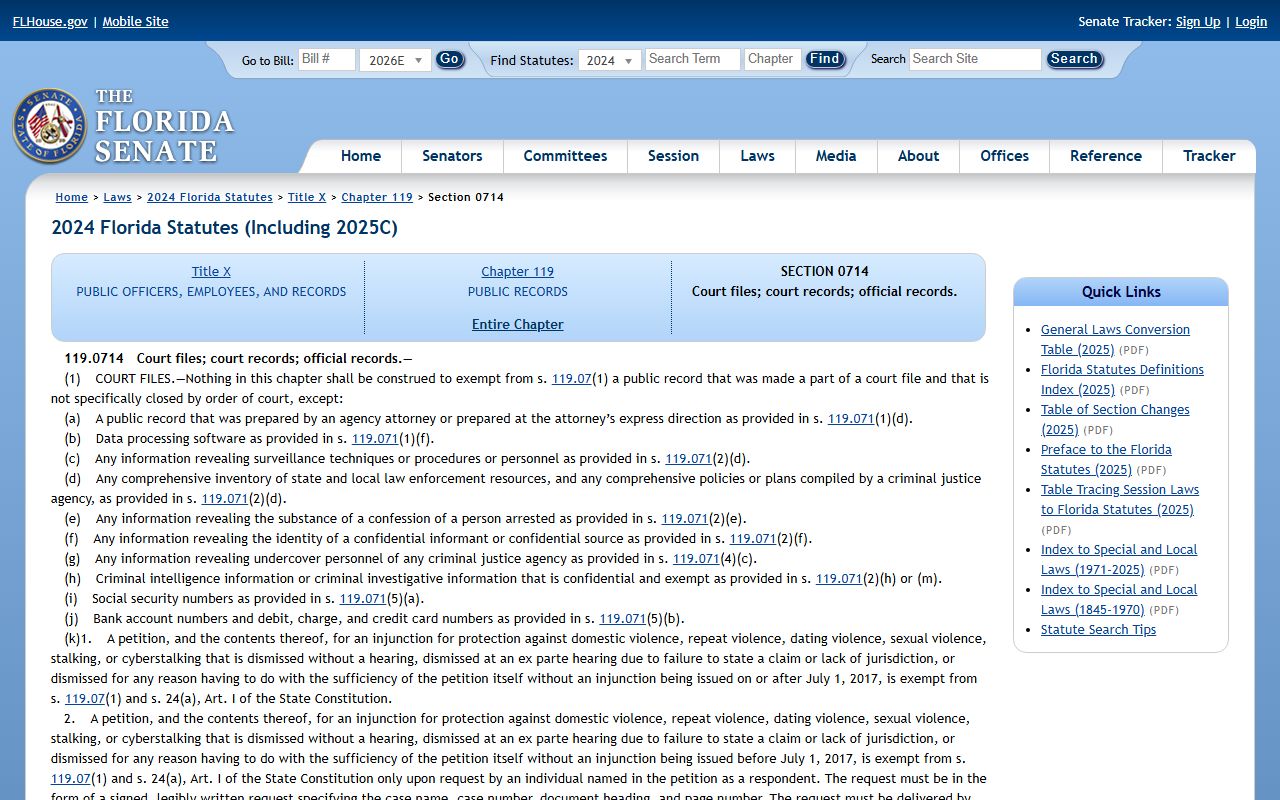
Rule 2.420 of the Florida Rules of General Practice and Judicial Administration also matters. The rule sets the framework for confidential filings, sealing, and notices of confidential information. The Clerk leans on this rule when a paper is hidden from public view.
Records That Are Restricted or Confidential
Not every Lee County court paper is open. Some files are closed by statute. Others are blocked by court order or by rule. The Clerk and the court treat these records as exempt from the normal public access rules.
The main restricted groups break down as follows.
- Juvenile delinquency and dependency - Section 985.04 keeps youth justice records confidential for general searches.
- Adoption - Section 63.162 makes adoption files confidential except through a court order.
- Mental health - Section 394.4615 protects clinical mental health content even when court events are noted.
- Sealed cases - any case may be sealed by judge's order; the case may still show in MATRIX as sealed.
- Expunged criminal records - Section 943.0585 removes many public copies and bars routine release.
- Viewable on Request filings - the Clerk must screen the paper before any release.
- Victim identifiers - Marsy's Law and Section 119.071 block victim names, addresses, and contact data in some cases.
To open a sealed file or to get an expungement, a person must follow the steps in the statute and file a petition. FDLE first issues a Certificate of Eligibility. The court then enters an order if the case qualifies. Section 943.0584 lists offenses that can never be sealed or expunged.
Specialty Courts in Lee County
The Twentieth Judicial Circuit uses problem-solving court calendars in Lee County. These courts run as dockets within the Circuit and County Court divisions, not as a separate clerk system. The Clerk's case file still tracks each step in MATRIX, though some treatment data stays out of the public file.
Programs in the circuit include drug court and treatment-oriented dockets, veteran-focused services, mental health dockets, and dependency or family treatment tracks. Early Resolution Calendars also help move some cases out of the trial track. A current public landing page that lists every specialty program with judge names, eligibility, and outcome data was not found in plain search. People who want to know if a case can move to a problem-solving docket should ask the assigned judge, the defense attorney, the State Attorney, or the Self-Help Center.
Note: Specialty court files often mix court papers with treatment notes, and the treatment side is rarely public.
Lee County Sheriff and Jail Information
The Lee County Sheriff's Office, led by Sheriff Carmine Marceno, runs the jail and books people arrested in the county. The agency has roughly 1,600 sworn and civilian staff. The Sheriff serves unincorporated Lee County, plus Bonita Springs, Estero, and Fort Myers Beach. Deputies have countywide power and back up city police in Fort Myers, Cape Coral, and Sanibel. The headquarters sits at 14750 Six Mile Cypress Parkway, Fort Myers. Non-emergency calls go to (239) 477-1000. Main Jail is at 2115 Martin Luther King Boulevard, Fort Myers, and can be reached at (239) 477-1500.
The Sheriff's website is the gateway for arrest search, recent bookings, recent releases, and visitation rules. The home page lists the leadership team and quick links to the Arrest Search tool. The site also warns about scams that use recent public booking data to call family members and demand gift cards.
Sheriff Carmine Marceno's office runs the booking, jail, and arrest search functions out of sheriffleefl.org, the official site for the agency.
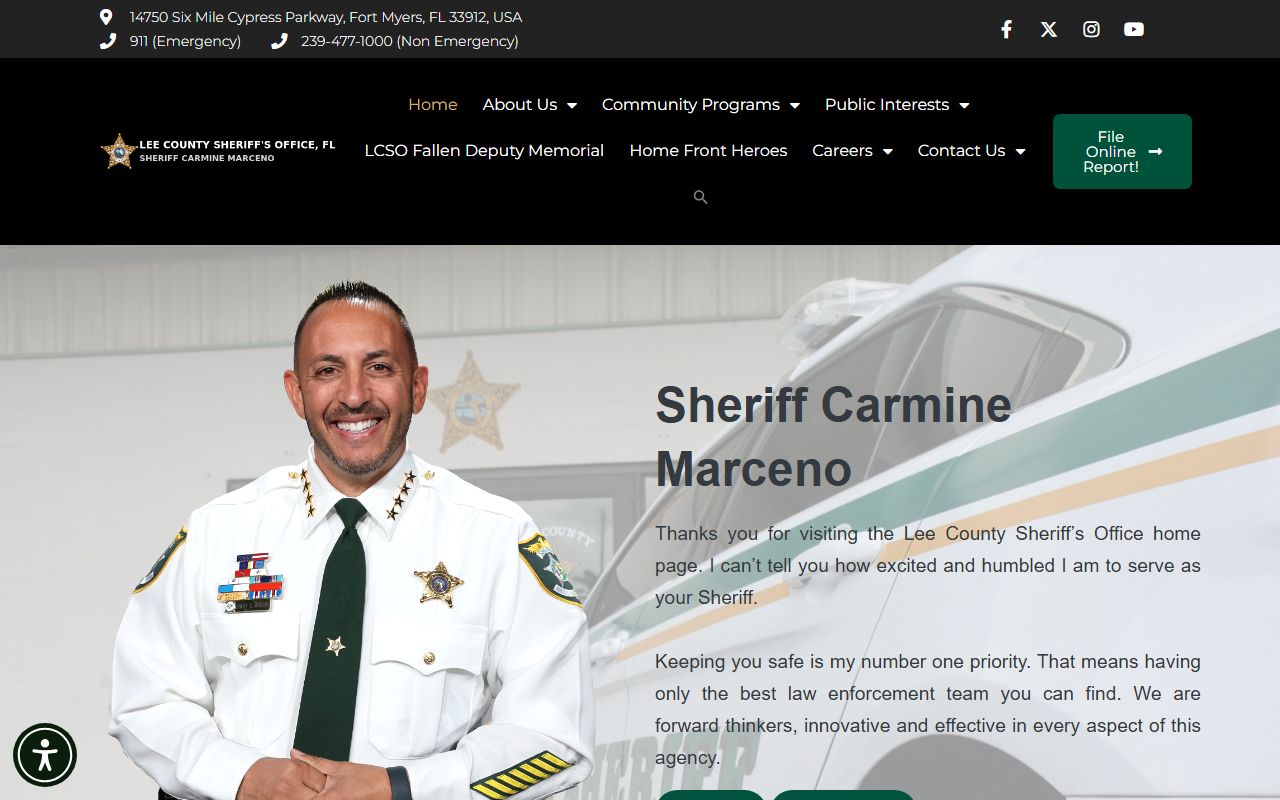
The Corrections Bureau runs three jail facilities with a total of 2,009 beds. The 2024 average daily population was 1,606. For booking and roster lookups, see the Lee County inmate records page. For open warrants, use the warrant records page. The released inmates page covers recent releases and notification tools.
Marriage, Divorce, and Probate Records
The Clerk keeps marriage records, divorce files, and probate cases in Lee County. Marriage licenses cost $86.00, or $61.00 with a four-hour premarital course. The Florida-resident waiting period is three days. A license is valid for ceremonies anywhere in Florida for 60 days. Divorce cases live under Domestic Relations in MATRIX, though public access is limited and registered or party access may be needed. The dissolution filing fee is $408.00. Full details sit on the marriage and divorce records page. Probate cases go through the probate records page, which covers formal administration, summary administration, and disposition of personal property without administration.
A few core probate terms come up again and again.
- Testator
- A person who has signed a valid will.
- Executor
- Florida calls this person the personal representative; the role is to gather assets, pay creditors, and pass the rest to heirs.
- Intestate
- Dying without a valid will; Florida intestate succession statutes then decide who inherits.
Lee County Court Records Fees
The Lee County Clerk of the Circuit Court & Comptroller posts a full fee schedule at leeclerk.org/services/fees-costs. Court filing fees, copy charges, and recording costs come from state statute and from the Clerk's own approved rates. The most common amounts are shown below.
| Item | Amount |
|---|---|
| Certified copy certification | $2.00 per certification |
| Certified copy page | $1.00 per page |
| E-Certified court document | $8.00 each |
| Circuit civil filing (other action) | $400.00 |
| County civil, $8,000 to $15,000 | $300.00 |
| Tenant eviction | $185.00 |
| Dissolution of marriage or annulment | $408.00 |
| Probate, opening estate proceeding | $231.00 |
| Formal probate / trust / conservatorship | $400.00 |
| Marriage license | $86.00 |
| Marriage license with premarital course | $61.00 |
| Notice of Appeal, County to Circuit | $281.00 |
| Notice of Appeal to District Court of Appeal | $100.00 |
| Driving history record, full | $16.25 |
The Social Security Administration does not accept electronically certified marriage records. People who need a license for a name change should buy a paper certified copy by mail or in person.
How to Interpret Lee County Court Records
A Lee County docket can look thick with codes. Each line stands for a filing, a hearing, an order, or a status change. The case number gives a quick read on what kind of case it is. The two letters after the year point to the case type. Codes like MM mean misdemeanor, CF means felony, CA means civil action, DR means dissolution, and CT means civil traffic.
Charges and convictions are not the same. A charge is the formal claim made by the State Attorney or by a citation. A conviction is the legal finding of guilt by plea or verdict. Florida also lets a judge withhold adjudication. With a withhold, the person pleads guilty or no contest, but the judge does not enter a formal conviction. The case still shows in the record. The plea can still affect immigration, license, and job background checks.
Other terms come up often. A docket is the chronological list. An order is a judge's written decision. A motion is a written request. Disposition is the case outcome. Bond is the money or condition that lets a defendant out of custody. Capias is a court command to arrest, often after a missed court date. Sealed means hidden from the general public but still kept by the Clerk under court order. Expunged means destroyed or returned, with a tight set of exceptions.
Accuracy, Updates, and Record Limitations
Lee County Court records are live. Filings post as the Clerk dockets them. Some entries change after staff review, court action, or a VOR check. The Clerk's court case records page warns that not every record is online and some types are limited by access level. Older records may have been removed from the public site under retention rules. Civil traffic and parking tickets, for example, drop off the public site once the case is closed, all money is paid, and the last docket entry is more than 14 months old, under Rule 2.430.
The Clerk lets users request a case summary or progress docket through the Records Request Tracking System at no charge for an electronic copy when the case has aged out of the public site. Verified Official Records on the recording side use an "R" or "I" label for provisional images and a "V" label for fully indexed entries. Build any reliance on the data with this difference in mind.
Note: Always confirm a Lee County Court record with the Clerk or the originating court before relying on it for a job check, a court filing, or any legal claim.
History of Lee County Courts
Lee County's court operations have grown alongside Southwest Florida. The courts now run out of the Lee County Justice Center complex in downtown Fort Myers. The Twentieth Judicial Circuit, which Lee shares with Charlotte, Collier, Glades, and Hendry counties, runs the trial benches.
The Clerk's office has reshaped how records reach the public over the last few years. Governor Ron DeSantis appointed Kevin C. Karnes as Clerk in March 2022, and voters elected him later that same year. The office has expanded electronic certification of court records so customers can get e-certified arrest reports, judgments, and dispositions from home through MATRIX at $8.00 per court document. Each e-certified file carries encrypted security features, a digital signature, and a verification code. Attorneys have been on mandatory e-filing for case filing fees since July 1, 2013. The Clerk also runs free seminars and webinars on how to search court records and how to access land and official records, including the January 2, 2025 online class that covered liens, plats, mortgages, lis pendens, marriage licenses, deeds, judgments, death certificates, and military discharges.
The Lee County Justice Center itself has been the public face of court records work for years. The official Twentieth Judicial Circuit page hosts current photos and floor-by-floor entry guidance for the complex.

The complex is the working hub for both Circuit and County Court business today.
Courthouse Location and Contact Information
The Lee County Justice Center sits in downtown Fort Myers. Court Administration uses 1700 Monroe Street as the mailing address. The Justice Center Proper or East Entrance shares that address. The Justice Center Tower and Annex use 2075 Dr. Martin Luther King Jr. Boulevard. The Information Desk picks up at (239) 533-9197 extension 0. Court Security and Lost and Found handle calls at (239) 533-2878 or email at CourtSecurity-Lee@ca.cjis20.org. Hours run 7:30 a.m. to 5:00 p.m. Monday through Friday and 7:30 a.m. to 1:00 p.m. on Saturday and Sunday. The Clerk runs court counters inside the Justice Center: Civil on the 2nd Floor, Felony on the 1st Floor, Misdemeanor and Ordinance on the 1st Floor, Probate and Guardianship on the 2nd Floor, Juvenile on the 2nd Floor, Domestic Violence and Injunction on the 1st Floor, and Jury Duty on the 2nd Floor.
Lee County Justice Center (East Entrance)
1700 Monroe Street
Fort Myers, FL 33901
(239) 533-9197 x0
Justice Center Tower (Clerk Counters)
2075 Dr. Martin Luther King Jr. Blvd
Fort Myers, FL 33901
(239) 533-5000
Cape Coral Clerk Branch
1039 SE 9th Place, 2nd Floor
Cape Coral, FL 33990
(239) 533-5000
Self-Help and Legal Aid Resources
The Lee County Clerk of the Circuit Court & Comptroller runs a Self-Help Center for people who file their own cases. The center sits inside the Justice Center and posts forms, how-to videos, and a seminar series. Staff cannot give legal advice, but they can answer procedural questions about how to file, where to file, and what a form means. The Clerk has also paired with Legal Aid for free appointments at the Justice Center for self-represented customers with legal questions. The Self-Help Center page sits at leeclerk.org/departments/courts/self-help-center.
Other options include Florida Courts Help for statewide forms, the Public Defender of the Twentieth Judicial Circuit for eligible criminal defendants, and the Office of the State Attorney's Victim and Witness Services for victims at sao20.org. The Lee County legal-services contacts page lists the Public Defender for the circuit. The Florida Bar lawyer referral and the Lee County Bar Association can point people to private counsel.
Frequently Asked Questions
How do I search Lee County court records online?
Use the Lee Clerk Court Records Inquiry at matrix.leeclerk.org. Pick case types, enter a name, case number, citation number, or date range, and click Search. Use MM/DD/YYYY for dates. Case results cap at 500. Hearing results cap at 200. To search by last name only, put an asterisk in First Name and the last name in Last Name.
Is the Lee County court records search free?
Yes. The Clerk's CRI training states the system is free and open 24 hours a day. Some files require registration or party access. Family, probate, guardianship, juvenile, and mental health cases may not return full results for the public.
Why can't I see a document in a case I found?
The Clerk follows the Florida Supreme Court Access Security Matrix and Rule 2.420. Some papers are confidential, sealed, or Viewable on Request. A VOR means the Clerk must check the file for confidential content before release. The case type and your role in the case set what you can view.
Where is the Lee County courthouse?
The Lee County Justice Center has public entrances at 1700 Monroe Street and 2075 Dr. Martin Luther King Jr. Boulevard in Fort Myers. The Information Desk picks up at (239) 533-9197 x0. Court Security is at (239) 533-2878.
How much does an e-certified court document cost?
Each e-certified court document is $8.00 through MATRIX. The file carries a digital signature and a verification code. The Social Security office does not accept electronic certifications, so a paper certified copy may be needed for some name-change tasks.
How do I find someone booked into the Lee County Jail?
Use the Sheriff Arrest Search at sheriffleefl.org/booking-search. Search by name, date of birth, booking number, custody status, or date range. The detail page links charges, case number, and bond status.
Can I search Lee County warrants online?
No normal public warrant page was located in this pass. The Sheriff has a public API endpoint, but it returned an empty result during inspection. Use MATRIX for capias or bench warrant docket entries, or contact the Sheriff Warrants Unit by phone or email.
More on the Lee County Court records FAQ page.