
The Lee County County Court
Florida runs a two-tier trial court model. The upper tier is the Circuit Court, a court of general jurisdiction. The lower tier is the County Court, a court of limited jurisdiction. Each of Florida's 67 counties has at least one County Court judge. Lee County is no different. The bench hears the bulk of routine case work that touches local residents and visitors. Misdemeanors. Traffic. Parking. Small claims. County and city ordinance matters. Lower-value civil suits. That mix is what gives the court its high volume.
The Twentieth Judicial Circuit oversees both court tiers in Lee County. Judges and staff share the same Justice Center complex in downtown Fort Myers. The Clerk of Court files, dockets, and stores County Court records under the same MATRIX search portal that holds Circuit Court files. That shared portal is why a name search at the Clerk pulls back hits from both tiers at once. Cases in the County Court move faster on the docket than felony trials. Most close within months, not years.
The court has its own fee schedule, its own filing windows, and its own appeal path. A County Court ruling can be sent up to the Circuit Court for review, not to the District Court of Appeal in most cases. That makes the County Court the first stop and the Circuit Court the second stop for many local cases.
Lee County County Court vs Circuit Court
The split between the two trial tiers is set by Florida law. Each court hears its own slice of cases. Money limits and crime grade decide where a case is filed. The chart below maps the line between the two.
| County Court | Circuit Court | |
|---|---|---|
| Civil limit | Up to $50,000 | Over $50,000 |
| Criminal cases | Misdemeanors and criminal traffic | Felony cases |
| Family cases | No | Yes (divorce, custody, paternity) |
| Probate | No | Yes |
| Traffic | Civil traffic, parking, criminal traffic | None at trial level |
| Ordinance cases | County and city ordinance | None at trial level |
| Small claims | Yes (up to $8,000) | No |
| Appeals from | County Court goes up to Circuit Court | Circuit Court goes up to District Court of Appeal |
The civil money cap is the line most people notice first. A claim for $20,000 in damages is a County Court file. A claim for $80,000 sits in Circuit Court. The grade of the crime works the same way. A first or second degree misdemeanor stays in County Court. A third degree felony or worse moves up. The clerk staff route filings to the right tier when papers come in, so litigants do not have to pick the court themselves.
Florida's two-tier setup is the model used in many southern states. The official structure is published by the state court system at the landing page below.
The Florida State Courts site lays out the four-level hierarchy in plain form, and the snapshot from flcourts.gov shows where County Court sits in that chain.
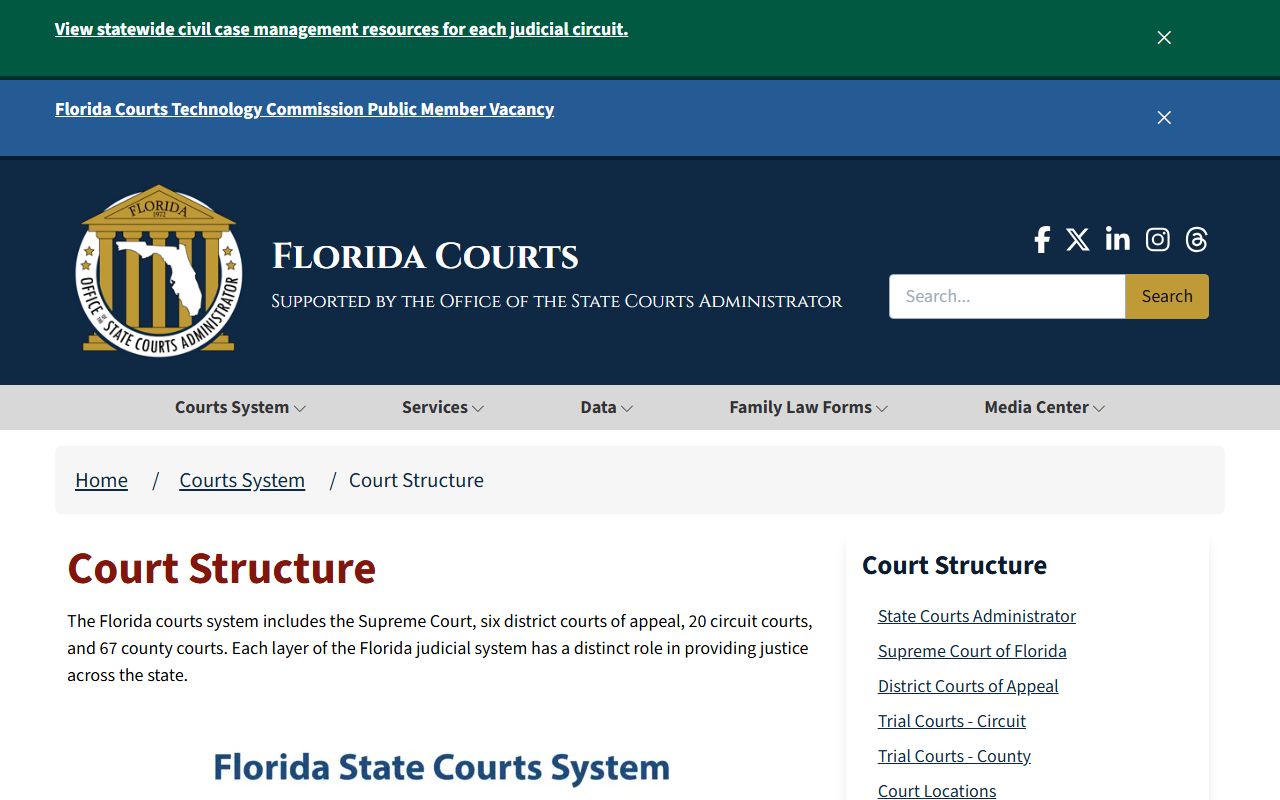
The page confirms that Florida runs Supreme Court, District Courts of Appeal, Circuit Courts, and County Courts as the four levels. Lee County County Court sits at the base, and most of its rulings move up to the Twentieth Judicial Circuit on review.
Case Types Handled in Lee County County Court
The Clerk's MATRIX search portal lists the case-type filters that match County Court files. Each filter is a record group the court keeps. The list below is the working set of County Court case types in Lee County.
- Misdemeanor: first and second degree criminal cases that fall short of felony grade.
- County Civil: civil suits under $50,000, including tenant evictions and contract claims.
- Small Claims: civil claims up to $8,000 with a simpler court process and lower fees.
- County Ordinance: local code violations filed by county code enforcement staff.
- Municipal Ordinance: city code violations from Fort Myers, Cape Coral, and other cities in the county.
- Traffic Infraction: civil traffic citations such as speeding, lane changes, and seat belt cases.
- CriminalTraffic: criminal traffic offenses such as driving with a suspended license and reckless driving.
- Parking Ticket: parking citation files held under the same portal as other traffic cases.
- Non Criminal Infraction: a catch-all class for non-criminal local violations not tied to traffic.
Each case type uses its own filing form and its own fee. The same Clerk staff handle all of them, but the work is split across the Misdemeanor, County Civil, and Traffic counters at the Justice Center. Cape Coral residents can file at the branch office. The Clerk's MATRIX portal exposes all of these case types as checkboxes in the search form.
Misdemeanor Cases
Misdemeanor cases are the criminal side of Lee County County Court. Florida divides misdemeanors into two grades. A first degree misdemeanor carries up to one year in jail and a fine of up to $1,000. A second degree misdemeanor carries up to 60 days in jail and a fine of up to $500. These thresholds are the general Florida limits. Common first degree charges include DUI, battery, and petit theft over a set value. Common second degree charges include disorderly conduct, trespass, and lower-value retail theft.
The Lee County Sheriff's Office books most misdemeanor arrests into the county jail. From there the case is filed with the Clerk and routed to the Misdemeanor counter. First appearance, plea, pretrial, and trial hearings all run from the Justice Center. The Clerk keeps the case file open in MATRIX through disposition. After the case closes, it stays on the public side of the docket unless sealed by court order. The criminal records page covers arrest and booking detail for misdemeanor defendants.
A misdemeanor case in Lee County normally moves through arrest, first appearance within 24 hours, arraignment, pretrial conference, and either plea or trial. Many cases close at the plea stage. The judge can impose jail time, probation, fines, community service, and court-ordered classes such as anger management or DUI school. Probation in County Court runs through the county probation office, not state probation.
Note: A no contest plea on a Florida misdemeanor still creates a public record and may still appear on a background check.
County Civil and Small Claims
The County Civil side of the court hears civil suits under $50,000. The Civil Department at the Clerk runs the filing side of these cases. Tenant evictions are the most common County Civil case in Lee County. The Clerk charges $185 to file a tenant eviction action. A standard civil action in the $8,000 to $15,000 range costs $300 to file. A civil action in the $15,000.01 to $30,000 range costs $400. The court also hears contract claims, debt collection cases, replevin suits, and other lower-value civil disputes.
Small claims is the lighter side of County Civil. The cap is $8,000. The forms are short. The hearings are quick. Pro se filers can move a small claims case from filing to judgment in a few months. Filing fees scale to claim size. A claim under $100 costs $55 to file. A claim of $500.01 to $2,500 costs $175. A claim of $2,500.01 to $8,000 costs $300. The small claims judge holds a pretrial conference first. Many cases settle there. If the case does not settle, the judge sets it for a final hearing.
Tenant evictions in Lee County follow a fast track. The landlord files a complaint and serves the tenant. The tenant has five business days to answer in writing, and the answer must include rent claimed unless the tenant disputes the amount. A default can issue if the tenant misses the deadline. The court can issue a writ of possession after judgment. The Clerk's Civil Department mails to P.O. Box 310, Fort Myers, FL 33902, and the phone option is 3.
Traffic and Ordinance Cases
Traffic and ordinance work is the highest-volume slice of Lee County County Court. Civil traffic infractions, parking tickets, and code violation cases all land here. The Clerk's traffic page sets the response window at 30 days from citation issuance. The driver must pay the ticket, pay and elect traffic school, or plead no contest within that window. Miss the deadline and a late fee can apply, with a possible driver license suspension. After 90 days, the unpaid citation may be sent to a collection agency with a 25% surcharge added to the balance.
County ordinance and municipal ordinance cases work the same way but with city or county code as the law in question. Code enforcement files the citation with the Clerk, and the case shows in MATRIX under the County Ordinance or Municipal Ordinance filter. Common ordinance cases in Lee County include short-term rental rule breaks, sign code cases, noise complaints, and property maintenance cases. Many ordinance cases settle with payment or compliance. Some go to a contested hearing.
Lee County criminal traffic cases such as driving on a suspended license, reckless driving, and DUI also start in County Court. DUI is a misdemeanor on a first or second offense and can move to felony grade after a third arrest or with serious bodily injury. The traffic court records page walks through citation search, payment, contesting a ticket, and the court traffic record versus the state driver record.
Searching Lee County County Court Records
The Clerk runs the public case search portal at MATRIX. The system is free, open 24 hours a day, and works on phones and tablets. A Lee County County Court case search uses the same form as a Circuit Court search, with case-type filters that narrow the result set to County Court files only.
- Open the Clerk's MATRIX portal at matrix.leeclerk.org.
- Pick the case types that fit a County Court file: Misdemeanor, County Civil, Small Claims, Traffic Infraction, CriminalTraffic, County Ordinance, Municipal Ordinance, Parking Ticket, or Non Criminal Infraction. Use the Check/Uncheck All option to clear other filters first.
- Enter a name, case number, or citation number. Use MM/DD/YYYY for dates. Put an asterisk at the end of a partial name to use the wildcard.
- To search by last name only, type an asterisk in the First Name box and the last name in the Last Name box.
- Click Search. Case searches show up to 500 results; hearing searches show up to 200.
- Click any case row to see the docket. If a document is marked Viewable on Request, submit a VOR request and the Clerk will screen it for confidential content.
- To find a court date, check View Court Calendar before running the search. The default date range is one year ahead.
Some case types have lower public access. Domestic Relations, Probate, Guardianship, Juvenile, and Mental Health files often need a registered or party login to view documents. County Court case types such as Misdemeanor, Small Claims, and Traffic Infraction are open to the general public. The court records page covers the wider search workflow, and the court dockets page covers calendar-only lookups.
Lee County County Court Filing Fees
The Clerk publishes the fee schedule for all court types. The most common County Court fees are listed below. Court costs and surcharges can be added on top.
| Case type | Fee |
|---|---|
| Small claims under $100 | $55.00 |
| Small claims $500.01 to $2,500 | $175.00 |
| Small claims $2,500.01 to $8,000 | $300.00 |
| Tenant eviction | $185.00 |
| County civil $8,000 to $15,000 | $300.00 |
| County civil $15,000.01 to $30,000 | $400.00 |
| Traffic moving infraction (non-speeding) | $161.00 |
| Non-moving / seat belt violation | $111.00 |
| Red light violation | $259.00 |
| Certified copy (certification) | $2.00 |
| Certified copy (per page) | $1.00 |
| Driving history record (full) | $16.25 |
The fee schedule is set by Florida statute and the Clerk's local order. Service of process, sheriff fees, and witness fees are not in this table. Fee waivers are available for filers who qualify as indigent under Florida Statutes section 57.082. The waiver form is available at the Clerk counter.
Lee County Clerk Departments That Handle County Court Cases
The Clerk runs three main counters that touch County Court work. Each has its own mailing address, its own phone option, and its own floor at the Justice Center. The Cape Coral branch handles many of the same case types for east and west Cape Coral residents.
The Justice Center page on the Twentieth Judicial Circuit site lists the public entrances, hours, and security rules for the complex. A snapshot of the Lee County Justice Center page is below.
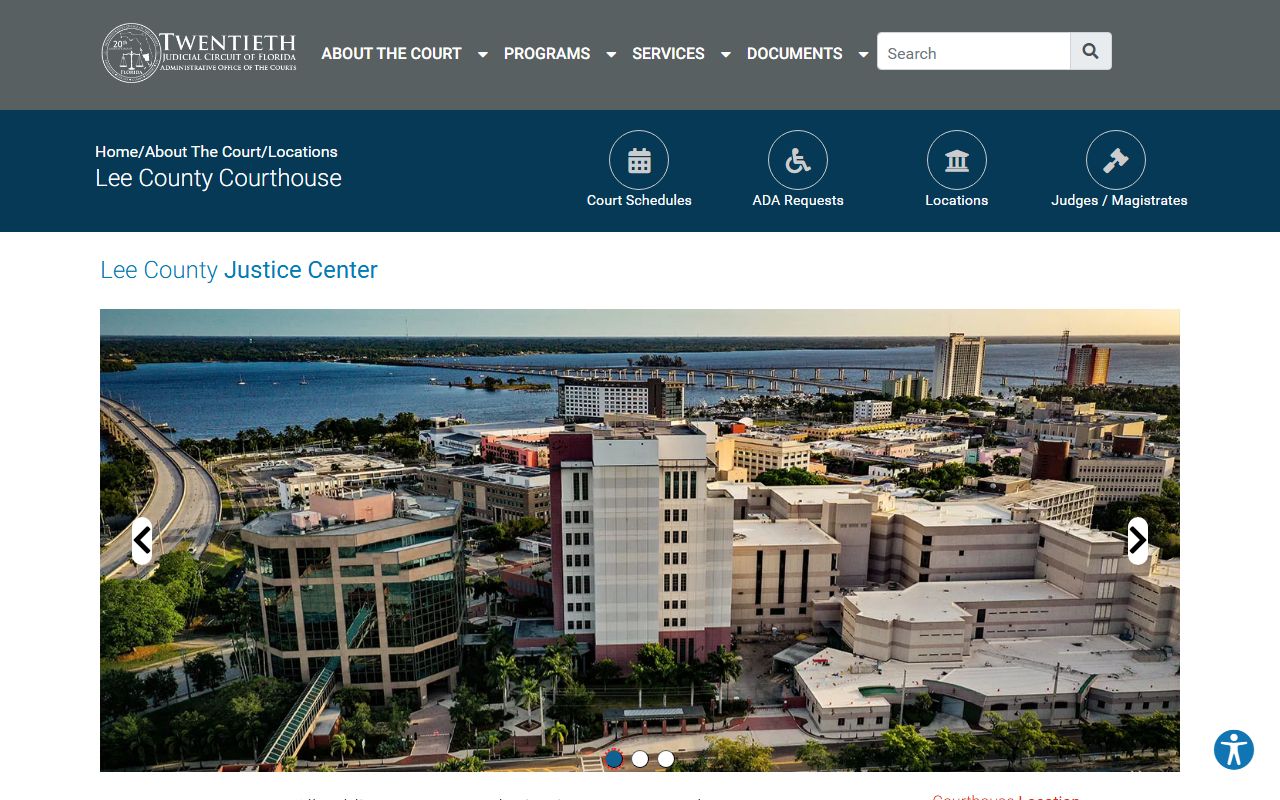
The page shows the East Entrance at 1700 Monroe Street and the Tower Entrance at 2075 Dr. Martin Luther King Jr. Boulevard. County Court counters on the 1st floor share the Tower lobby with felony intake. The Clerk staff route filers to the right counter as they walk in.
Misdemeanor / Ordinance Department
P.O. Box 2507
Fort Myers, FL 33902
(239) 533-5000 option 2
Justice Center 1st Floor
Also at Cape Coral Branch
Civil Department (County Civil and Circuit Civil)
P.O. Box 310
Fort Myers, FL 33902
(239) 533-5000 option 3
Justice Center 2nd Floor
Cape Coral Branch
1039 SE 9th Place, 2nd Floor
Cape Coral, FL 33990
(239) 533-5000
Misdemeanor, ordinance, civil intake
The Cape Coral branch is a working option for Cape Coral, North Fort Myers, and Lehigh Acres residents who want to skip the trip across the bridge. It does not host trials, but it takes filings, payments, and copy requests for County Court matters. The Clerk of Court page covers all Clerk services in detail.
Appeals from County Court
A County Court ruling in Lee County is not the end of the line. A party who loses can ask a higher court to review the case. The path runs up to the Circuit Court for most County Court appeals, not to the District Court of Appeal. The Circuit Court sits as an appellate panel for these reviews. The notice of appeal must be filed within 30 days of the order being appealed.
The Clerk charges $281 to file a Notice of Appeal from County Court to Circuit Court. A second-level appeal from a Circuit Court appellate ruling to the District Court of Appeal costs $100 to file. The DCA hears Florida appellate cases for this region from its courthouse in Lakeland, with the Second District covering Lee County under the 2023 structure change. Most County Court appeals close at the Circuit Court stage.
Appellate cases create their own case file in MATRIX, with the case-type filter set to Appeals. The record on appeal includes the trial docket, transcripts, exhibits, and the order being challenged. The Clerk prepares the record after the notice of appeal is filed, and the parties pay for any transcripts they want included.
Common Questions
Two of the most common questions about Lee County County Court are below. The FAQ page has the full set.
Q: Do I need a lawyer for a small claims case in Lee County?
No. Small claims is set up for pro se filers. Most plaintiffs and defendants in small claims appear without a lawyer. The judge is used to that and will walk both sides through the steps at the pretrial conference. A lawyer is allowed if a party wants one, but it is not required.
Q: How do I find a Lee County misdemeanor case online?
Open MATRIX at matrix.leeclerk.org. Check the Misdemeanor case type box. Enter the name or case number. Click Search. The case docket, hearing dates, and most non-confidential documents will appear in the result. The full search workflow is on the court records page.