
How to Search Lee County Marriage and Divorce Records
Two portals do most of the work in Lee County. Marriage licenses and recorded marriage certificates are searchable through the Clerk's Landmark Official Records system. Divorce files, listed in the courts as Domestic Relations cases, are searched in the Clerk's MATRIX court records system. Both are free to use. Both are open 24/7. Each one shows different data, so the right tool depends on the record type.
For a Lee County marriage records search, open Landmark Official Records and pick the name search mode. Type the bride or groom name. Add a date range if the wedding year is known. The system pulls back the recorded marriage license image and any related filings. The search supports name, document type, case number, book and page, record date, clerk file number, and legal description modes. Spelling counts. The Clerk warns users to try all spelling variations.
For a divorce, open MATRIX. Pick Domestic Relations under Case Types. Enter a party last name, case number, or date range. Use MM/DD/YYYY for dates. Hit Search. Results show case numbers, party roles, filing dates, and the docket. Document images may be blocked. The Clerk's training material says family case searches will not return complete results for the general public, and that registered or party access may be needed to pull certain documents.
Some details are easy to miss. MATRIX supports a wildcard. Type part of a last name and add an asterisk to catch spelling drift. Case searches cap at 500 results. Hearing searches cap at 200. Domestic Relations covers dissolution of marriage, annulment, paternity, custody, support, and modification cases. The right case type filter trims the noise.
The Lee County Marriage License Process
Lee Clerk runs the marriage license desk through its Official Records Services division. The Clerk's marriage licenses and ceremonies page spells out a two-step path. First, the couple completes the online application. Then both parties appear together for issuance and signing. A Florida marriage license can be issued in any county and is valid in any county for 60 days from the effective date. The license can only be used for ceremonies held in Florida.
The two-step structure trips up some couples. The online step is not the license itself. The license is not legal until the couple shows up in person to sign it and the Clerk issues it. Both people must come to the counter at the same time. Both must bring valid ID. Both must sign in front of Clerk staff. After that, the license becomes effective and the clock starts.
- Open the online application on the Lee Clerk marriage license page and complete the form for both parties. Save the confirmation.
- Choose a Clerk location. Official Records works out of the downtown Fort Myers office and a Cape Coral branch on SE 9th Place.
- Appear together. Both parties must come in person at the same time, bring photo ID, and bring the premarital course certificate if one was completed.
- Sign the license in front of Clerk staff and pay the fee. Card or cash payment is accepted at the counter.
- Wait three days if the Florida-resident waiting period applies and no course waiver is in hand. Non-Florida residents get the license right away.
- Hold the wedding in Florida within 60 days of the effective date. The license is void after that window.
- Return the signed license to the Clerk for recording. Order a certified copy if needed for a name change or a benefits claim.
Marriage License Requirements
Florida law sets the rules for who can get a marriage license and how it must be issued. Lee Clerk follows the state framework. The issuing officer is the county court judge or the clerk of the circuit court. Both parties must be at least 18, or 17 with limited consent under tight conditions. Both must show valid government photo ID, give a Social Security number where one exists, and disclose any prior marriage and how it ended. Same-sex marriage has been legal in Florida since 2015, and the application treats both parties the same.
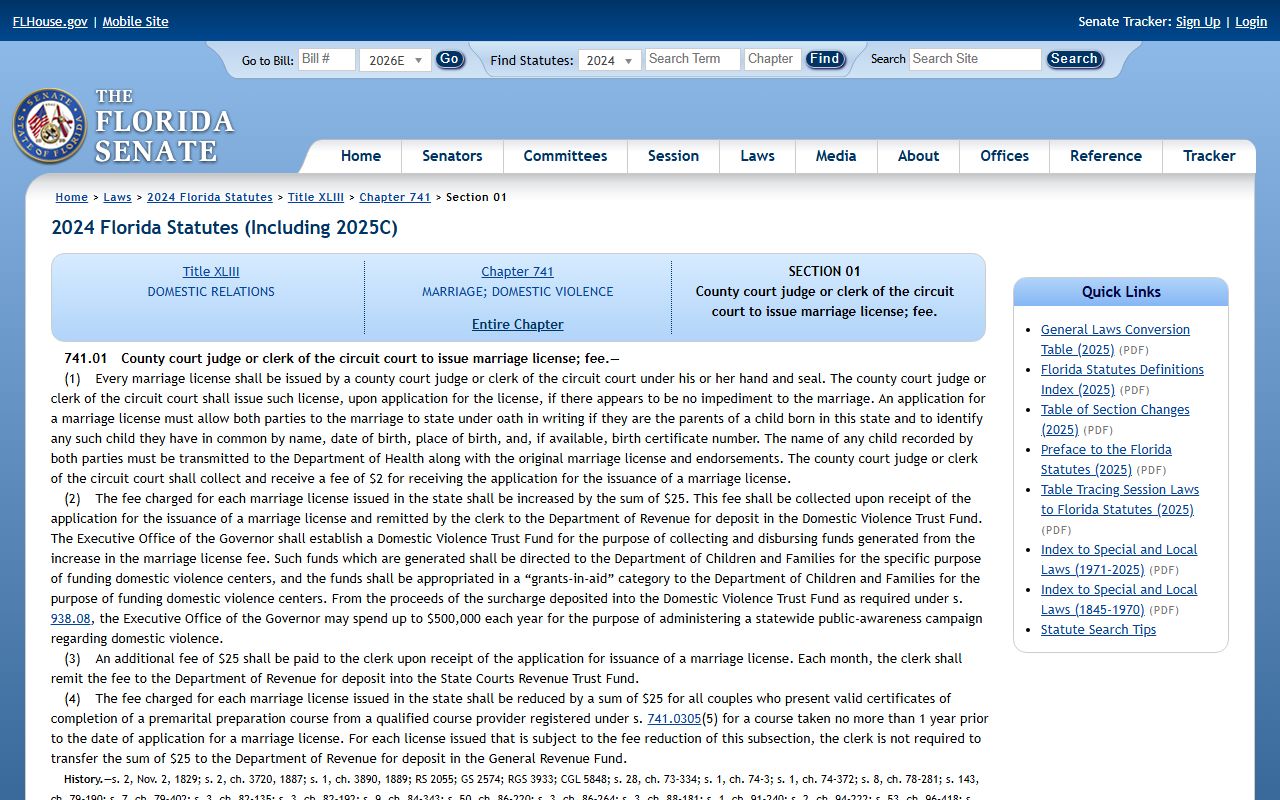
The image below shows the state law that gives clerks the power to issue a marriage license. Section § 741.01 places that duty with the county court judge or the clerk of the circuit court.
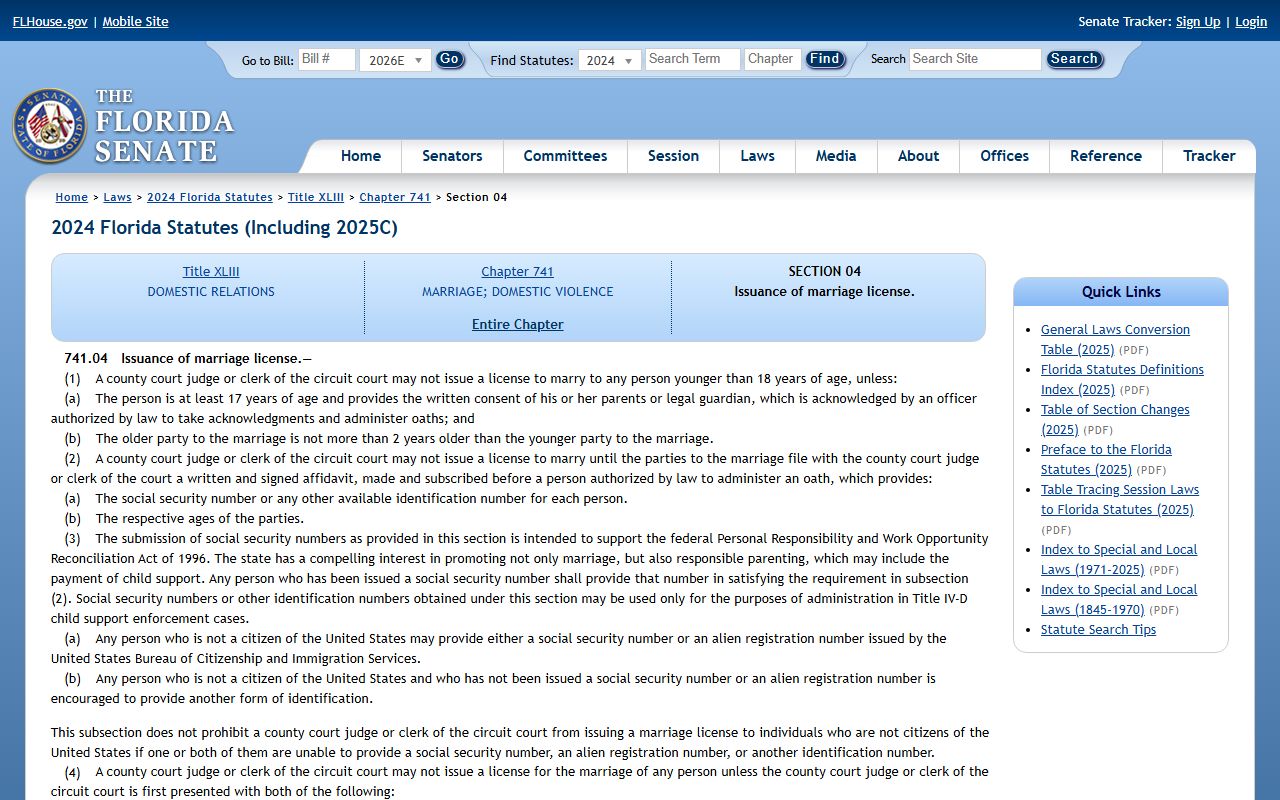
The companion statute sets the requirements both parties must meet before the license issues. It covers age, consent, the waiting period for Florida residents, and the premarital course waiver. See § 741.04 for the full rule.
Couples should bring more than just an ID. Bring proof of any name change from a prior marriage, divorce decree details if asked, the premarital course completion form, and a way to pay the fee on the spot.
Key Statutes for Lee County Marriage Licenses:
- Florida Statutes § 741.01: marriage licenses issued by the county court judge or the clerk of the circuit court.
- Florida Statutes § 741.04: marriage license requirements, age and consent rules, and the waiting-period framework.
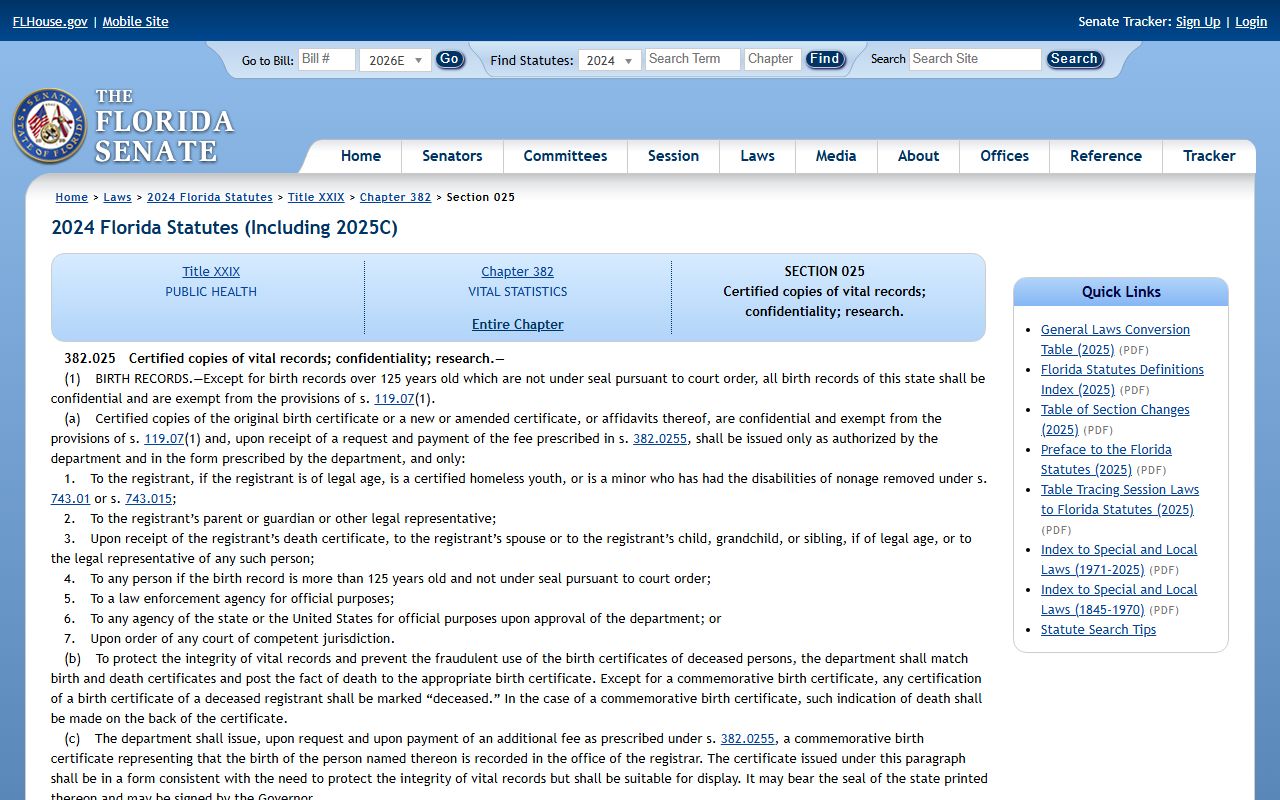
- Florida Statutes § 382.025: disclosure and certification of vital records, including certified marriage records.
Lee County Marriage License Fees
The Lee County marriage license fee depends on residency and whether the couple finished a premarital course. The course buys two things at once. It lowers the fee and it wipes out the three-day wait. The Clerk also charges extra for certified copies, for a Clerk-officiated ceremony, and for a lost-license affidavit. All amounts come from the Lee Clerk fee schedule.
| Item | Amount |
|---|---|
| Standard marriage license | $86.00 |
| Marriage license with qualifying premarital course | $61.00 |
| Additional certified copy of license | $3.00 |
| Clerk-performed marriage ceremony | $30.00 |
| Lost or stolen marriage license affidavit | $10.00 |
Payment is due at the time the license is issued. The Clerk takes cash and major cards at the counter. A check from one of the parties is also fine at most locations. Couples in mixed-residency cases pay $86 unless the Florida resident in the pair takes the four-hour course. In that case the fee drops to $61 and the wait goes away.
Marriage License Waiting Period and Premarital Course
Florida builds in a short cooling-off period for residents. If one or both parties is a Florida resident, the couple must wait three days before the license becomes effective. The wait is meant to give the pair time to think it over. Non-Florida residents get no waiting period. The license is effective the day it issues for an out-of-state couple. That makes Lee County a common stop for destination weddings on Sanibel and Captiva.
The waiting period can be waived. The waiver is a four-hour premarital preparation course from a state-approved provider. Both parties must finish the course. The course covers communication, conflict, finances, and shared goals. Once the certificate is in hand, the Florida resident pair can take the license home the same day and the fee drops by $25.
A Florida resident pair without the course pays $86 and waits three days. A Florida resident pair with the course pays $61 and waits zero days. A non-Florida pair pays $86 and waits zero days. A non-Florida pair with the course pays $61 and still waits zero days. A mixed pair follows the Florida resident rule unless the Florida resident takes the course.
Once the license is effective, the 60-day clock starts. The wedding must take place inside Florida within those 60 days. A ceremony held after day 60 does not result in a legal marriage from that license. If the wedding gets pushed back, the couple has to apply for a new license.
Certified Copies and the Social Security Caveat
A certified copy is the official proof of marriage. Banks, the DMV, the Social Security office, employers, credit card issuers, and many insurers want one before changing a name on file. The Clerk records the signed license after the ceremony and the recorded version becomes the marriage certificate. Couples can order extra certified copies at the counter, by mail, or online through the Clerk's e-certified service.
The image below shows the state law on vital records disclosure. Section § 382.025 sets when and how a certified marriage record can be released.
Lee Clerk offers both paper and electronic certified copies. The e-cert costs $8 per document, gets to the buyer in minutes, and includes a verification code so any agency can confirm it is real. The paper certified copy costs $3 for the extra marriage copy, takes longer, and arrives by mail or pickup. There is one big exception that catches many newlyweds off guard.
Important: Social Security does not accept e-certified copies. The Social Security Administration will not take an electronically certified marriage record for a name change. A paper certified copy must be ordered by mail or picked up in person from the Lee Clerk Official Records office. Plan ahead if the new name needs to land on a Social Security card before a passport renewal or employer paperwork.
Where to Search Lee County Marriage Records
Lee Clerk hosts the full Lee County marriage records archive on its Landmark Official Records site. The portal lives at or.leeclerk.org/LandMarkWeb. The Clerk's training material confirms that free marriage license record copies can be looked up in Official Records, with certified copy options on the Copies of Documents page. Search by party name, document type, recording date, book and page, or clerk file number.
Landmark also handles deeds, mortgages, liens, and other recorded instruments, so narrowing the document type to marriage records cleans up the result list. The portal shows the recorded image of the license once the case is complete. Provisional records show an R or I marker. Verified records show a V. The Clerk warns that provisional records may change before final verification, so a copy pulled the day after the ceremony may not be the final image.
For records from a license issued in another county or another state, the search shifts to that jurisdiction. Lee Clerk only holds records issued or recorded in Lee County. A couple married in Collier County back in 2010 needs to call that clerk, not Lee. The Florida Bureau of Vital Statistics holds the statewide marriage index but routes most certified-copy orders back to the issuing county clerk.
Where to Find Lee County Divorce Records
Divorce in Florida is a court case. Lee County divorce records are filed in the Circuit Court family division and indexed by the Clerk under Domestic Relations. The Lee County divorce records search lives in MATRIX. Pick Domestic Relations from the case type list. Enter a name, case number, or date range. The system returns the case header, party names, filing date, and the docket. Image access depends on user role.
Public users see less than registered users. Registered users see more than the public but still cannot pull every document. Parties to the case and their attorneys see the most. Lee Clerk's case access training PDF notes that family records have limited public image access because of the sensitive content in those files. Income statements, custody plans, and addresses of victims of domestic violence sit in many divorce files. The Clerk hides those by default.
To gain registered access, send a request to CRIaccounts@leeclerk.org, mail it to P.O. Box 3207 with notary information, or apply in person at the Courts Customer Service Counter at 2075 Dr. Martin Luther King Jr. Boulevard. The Clerk replies within 48 business hours. Party access goes further but is reserved for the people named in the case. For older closed divorces or documents not online, the Clerk's Records Request System handles the lookup.
Divorce Filing Fees in Lee County
The Clerk charges a flat filing fee for most family case types. The fee covers the petition, the case open, and the initial docket. It does not cover service of process, mediation, or any later motions. The amounts below come from the Lee Clerk fee schedule and apply at the time of filing.
| Family Case Type | Filing Fee |
|---|---|
| Dissolution of marriage / annulment | $408.00 |
| Separate maintenance | $310.50 |
| Custody / visitation / paternity / support | $300.00 |
| Modification of final judgment (re-open) | $50.00 |
| Injunction for protection | $0.00 |
A petitioner who cannot afford the fee can file an Application for Determination of Civil Indigent Status. If the Clerk finds the petitioner indigent, the filing fee is waived. Self-represented filers can use the Florida Supreme Court family law forms set, available through the state courts site. For a contested case, an attorney typically files through the Florida ePortal and the fee posts at submission.
Family Record Access Limits
Domestic relations files are public records, but not the way a deed or a misdemeanor citation is public. Florida law and Florida Rule of General Practice and Judicial Administration 2.420 push for the redaction or restriction of sensitive items. The Clerk MATRIX system honors those rules at the search layer. A public search shows the case shell. Many documents inside are marked Viewable on Request or are blocked from anonymous view.
Items that often stay restricted include financial affidavits, parenting plans with minor identifiers, attorney fee declarations, mediated settlement details, and domestic violence injunction filings. Adoption files, while not a divorce, are fully sealed under Florida Statutes § 63.162. Mental health proceedings and juvenile dependency matters carry their own confidentiality layers.
A person who needs a sealed item must usually be a party to the case, a party's attorney, or someone with a court order. The Clerk cannot release a sealed document on a routine request. A motion to unseal goes to the same judge who handled the case. The court weighs the public interest against the privacy interest before any release.
For most users, the open part is enough. A divorce search confirms a divorce happened, gives the case number, shows the filing date, and points to the final judgment. That covers most remarriage and benefits needs. For the full record, the Clerk's Records Request System lets a party order a complete certified copy of a final judgment of dissolution.
Common Questions
Three questions come up over and over at the marriage license counter and on the Clerk's call line. Quick answers below. The full Lee County court records FAQ covers more ground.
Can a Lee County marriage license be used in another state? No. A Florida marriage license is only valid for a ceremony performed in Florida. The license can be used in any Florida county, not just Lee. A couple married out of state must apply in that state.
Is the three-day waiting period waived for an emergency? Generally no. The only standing waiver is the premarital course. There is no special hardship waiver in Florida for Lee Clerk to grant. Non-Florida residents skip the wait by default.
How long does the Clerk keep marriage and divorce records? Marriage license records are kept permanently in official records. Divorce case files follow Florida Rule of General Practice and Judicial Administration 2.430 retention rules and remain searchable in MATRIX long after the case closes.