
The Lee County Circuit Court
Florida runs a two-tier trial court system. The Circuit Court is the higher of the two tiers and hears the broadest range of cases. The Lee County Circuit Court is the local seat of that system. It handles felonies, family law, probate, guardianship, juvenile cases, mental health matters, and civil suits over a set dollar limit. The court also issues injunctions and rules on real-property title actions.
The court sits inside the Twentieth Judicial Circuit. Day-to-day court files, dockets, and case index data are kept by the Lee County Clerk of the Circuit Court and Comptroller. The Clerk runs the public case search portal at matrix.leeclerk.org, where most circuit court records can be looked up by name, case number, or citation. Some case types stay limited to registered users or parties.
Cases here flow under the Florida Constitution, the Florida Rules of General Practice and Judicial Administration, and the Florida Statutes. The state Supreme Court court-structure page spells out where the Circuit Court fits between the County Court below and the District Court of Appeal above.
The Twentieth Judicial Circuit
The Twentieth Judicial Circuit serves five counties on Florida's southwest coast. Those counties are Lee, Charlotte, Collier, Glades, and Hendry. The circuit shares a chief judge, a court administrator, and a single set of administrative orders. Each county still has its own clerk and its own courthouse. Lee County is the largest of the five and holds the bulk of the circuit's case load.
The Twentieth Circuit posts its court rules, division assignments, and judge rosters on the official site at ca.cjis20.org. Judges in Lee County may rotate between divisions over time, so the division-assignment order is the best source for who hears what at any given point. The State Attorney for the circuit is housed at the Office of the State Attorney, Twentieth Judicial Circuit.
The five counties share a Public Defender's Office and a court technology consortium known as CJIS Twentieth. The shared model lets the circuit pool resources for case management, jury operations, and judicial education.
Circuit Court vs County Court
Florida law splits trial work between two courts. The Circuit Court takes the bigger civil cases and almost all of the heavy criminal work. The County Court takes smaller civil claims, minor crimes, traffic, and local code matters. The table below sets out the main lines.
| Circuit Court | County Court | |
|---|---|---|
| Civil limit | Over $50,000 | Up to $50,000 |
| Criminal jurisdiction | Felonies | Misdemeanors and ordinance |
| Family cases | Yes | No |
| Probate and guardianship | Yes | No |
| Juvenile and mental health | Yes | No |
| Traffic and parking | No | Yes |
| Appeals heard | Hears appeals from County Court in some cases | Trial level only |
For more on lower-level matters, see the Lee County County Court page.
Circuit Court Case Types
The Circuit Court hears a broad mix of cases. Each case type has its own filing rules, fees, and forms. The Clerk's MATRIX search portal lets users filter by case type to narrow results.
- Felony cases (any crime that can lead to more than one year of state prison time).
- Circuit civil suits where the amount in dispute is more than $50,000.
- Family law cases (dissolution of marriage, paternity, custody, support, name change).
- Probate and trust cases (formal administration, summary administration, will contests).
- Guardianship cases for minors and adults found to lack capacity.
- Juvenile delinquency and dependency cases (with strict access limits).
- Mental health and involuntary commitment cases under the Baker Act and Marchman Act.
- Real-property title disputes, foreclosures, quiet title, and partition actions.
- Injunctions for protection against domestic, dating, repeat, sexual, or stalking violence.
- Extraordinary writs and declaratory judgment actions.
Felony case numbers in Lee County often start with the two-digit year, then "CF" for circuit felony, then a sequence. Family files tend to use "DR" and probate files use "CP." The case-type code is built into the case number itself, which makes the case type easy to read from the docket.
Circuit Court Divisions in Lee County
The Clerk staffs separate counters and PO boxes for each main division. The split keeps filings, payments, and records pulls moving fast at the Justice Center. The chart below pulls from the Clerk's contact and locations page.
| Division | Floor | Mailing PO Box | Phone Option |
|---|---|---|---|
| Civil | 2nd Floor | P.O. Box 310, Fort Myers, FL 33902 | (239) 533-5000 option 3 |
| Felony | 1st Floor | P.O. Box 2507, Fort Myers, FL 33902 | (239) 533-5000 option 2 |
| Probate, Guardianship, Mental Health | 2nd Floor | P.O. Box 9346, Fort Myers, FL 33902 | (239) 533-5000 option 5 |
| Juvenile | 2nd Floor | P.O. Box 9347, Fort Myers, FL 33902 | (239) 533-5000 option 6 |
| Domestic Violence / Injunction | 1st Floor | Justice Center | (239) 533-5000 option 4 |
| Jury Duty | 2nd Floor | P.O. Box 9349, Fort Myers, FL 33902 | (239) 533-2929 |
Misdemeanor and traffic work runs through the County Court on the 1st floor of the same building and at the Cape Coral branch. For probate-specific guidance, see the Lee County probate records page. Civil cases of all sizes file at the 2nd floor civil counter.
Note: Some divisions limit public online access to court documents, so a counter visit or VOR request may be needed for sealed or restricted files.
The Lee County Justice Center
The Lee County Justice Center holds the Circuit Court, the County Court, the Clerk's main court counters, and Court Administration. The complex sits in downtown Fort Myers. It has two main public entrances. The East Entrance, also called the Justice Center Proper, opens on Monroe Street. The South Entrance, also called the Justice Center Tower, opens on Dr. Martin Luther King Jr. Boulevard. An image of the Justice Center is posted on the Twentieth Judicial Circuit locations page.
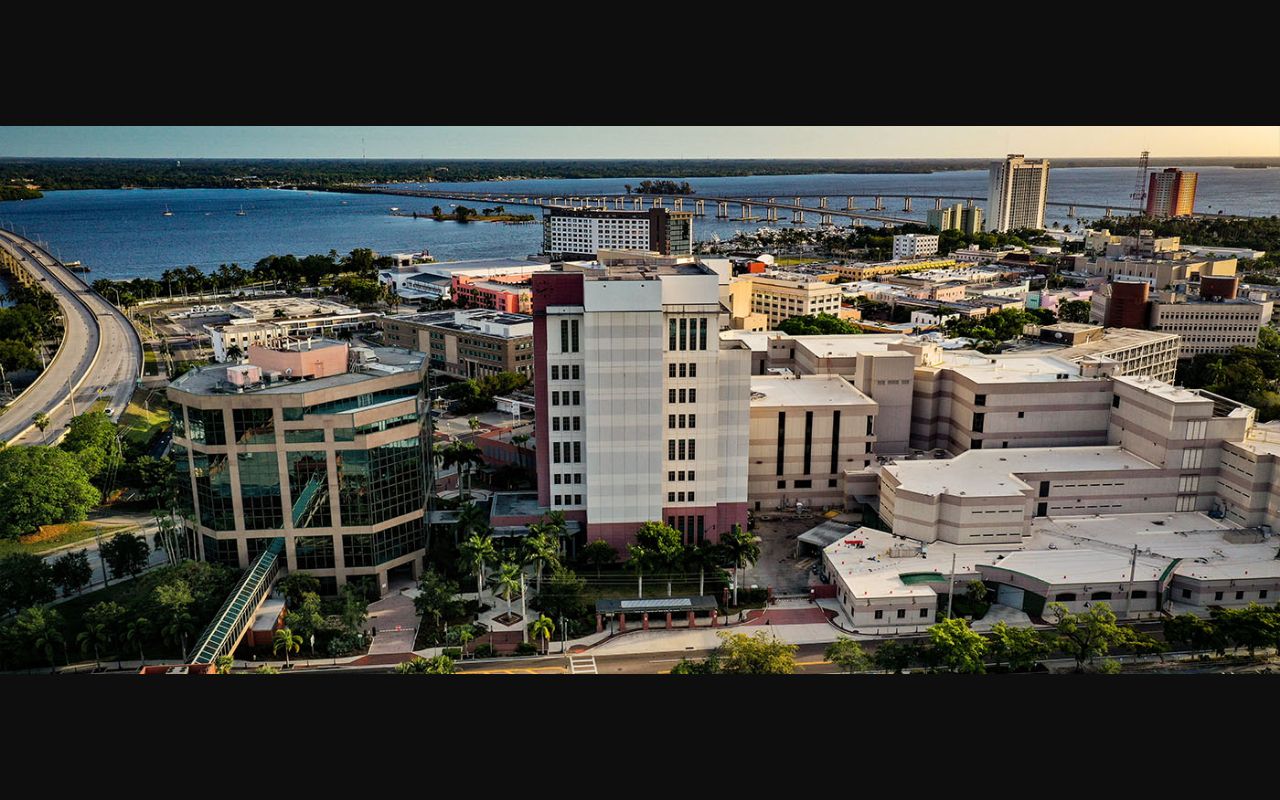
The Justice Center building is the home of all circuit court trials in the county. Public parking sits at the corner of Dr. Martin Luther King Jr. Boulevard and Heitman Street, across from the MLK entrance. Jurors have a separate lot at 2050 Broadway.
| Justice Center (East Entrance) | 1700 Monroe Street, Fort Myers, FL 33901 |
|---|---|
| Justice Center Tower (South Entrance) | 2075 Dr. Martin Luther King Jr. Boulevard, Fort Myers, FL 33901 |
| Information Desk | (239) 533-9197 x0 |
| Court Security and Lost & Found | (239) 533-2878 |
| Clerk Main Line | (239) 533-5000 |
| Court Administration Mailing | 1700 Monroe Street, Fort Myers, FL 33901 |
| Public Hours (Weekdays) | 7:30 a.m. to 5:00 p.m. |
| Public Hours (Weekends) | 7:30 a.m. to 1:00 p.m. |
The complex stays open on a set schedule. Most court hearings run during weekday business hours, while weekend access is limited to short windows for first-appearance dockets and similar limited matters.
How a Case Moves Through the Lee County Court System
The path of a case depends on the case type. Felony cases and civil cases follow different tracks, but both end with a final order that can be tested on appeal. The flow below is the standard route in Lee County.
- Arrest or filing. A felony case starts with a sworn complaint, a probable cause affidavit, or a grand jury indictment. A civil case starts when a party files a complaint and pays the filing fee.
- First appearance. Anyone held in jail sees a judge within 24 hours. The judge sets bond and reads the rights of the accused.
- Charging. The State Attorney files an Information or seeks an indictment for felonies. Civil defendants are served and file an Answer.
- Arraignment. The defendant enters a plea in open court. Discovery starts in both criminal and civil tracks.
- Pretrial. Both sides file motions, take depositions, and may try mediation in civil cases. Most cases settle or plead out here.
- Trial. A jury or judge hears the proof. Felony juries seat six members in most cases and twelve in death penalty cases.
- Sentencing or judgment. The judge enters a sentence in a criminal case or a written judgment in a civil case.
- Appeal. A party may file a notice of appeal within the time limits. Most Lee County Circuit Court appeals run to the District Court of Appeal.
The Clerk's court case records page shows each step as it lands on the docket. A live Lee County court docket view often lists the next hearing date and time once the case is set.
Appeals to the District Court of Appeal
Most appeals from the Lee County Circuit Court go to the District Court of Appeal. Florida has six DCAs after a 2023 update to the appellate map. Each DCA hears appeals from a fixed group of circuits. The Twentieth Judicial Circuit falls in the Second DCA region. The Florida court-structure page from the state Supreme Court lays out the appellate map in full.
The Florida courts landing page at flcourts.gov shows where the Circuit Court sits in the larger state judicial system.
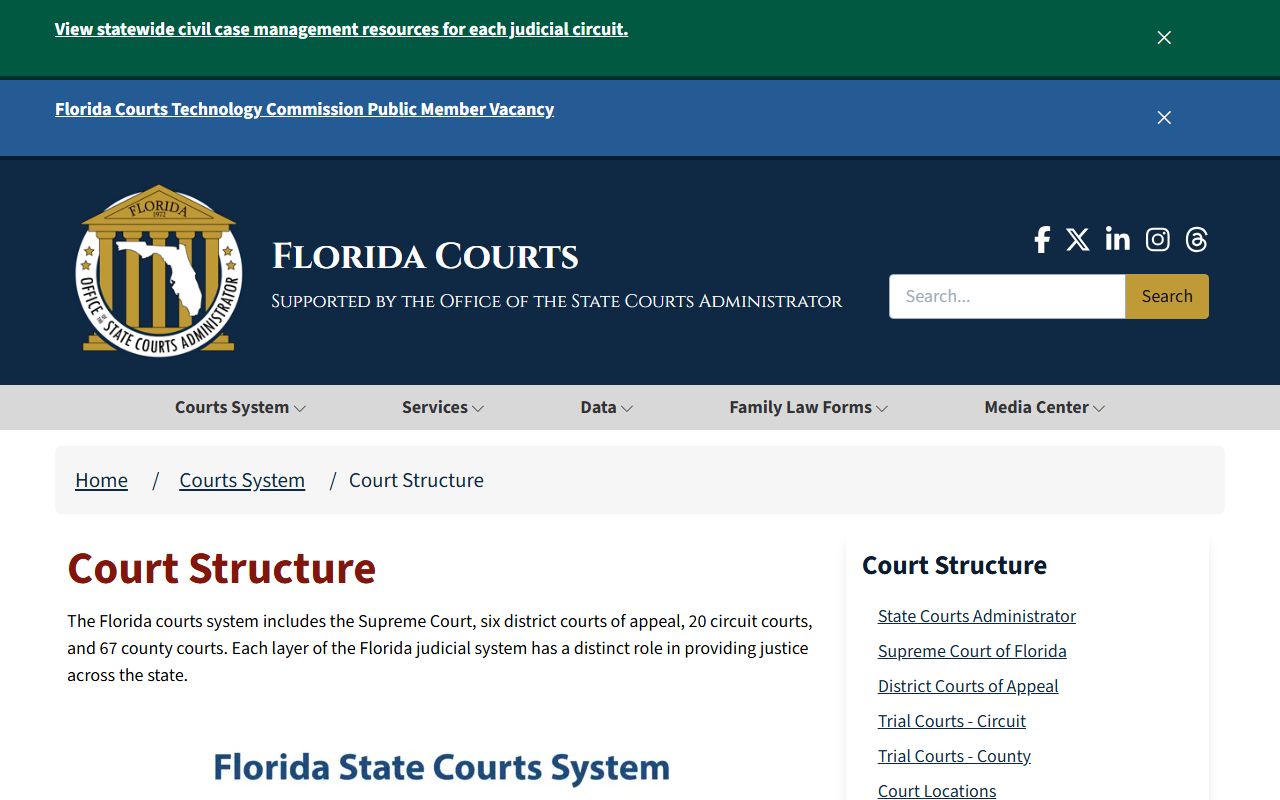
The page helps frame how a Lee County case can move up the ladder. Notice of appeal fees from Circuit Court or County Court to the DCA run $100 at the Clerk's counter. The DCA decision is final for most cases. The Supreme Court of Florida takes only narrow classes of cases on further review, such as death penalty cases or cases of great public importance.
The six DCAs sit in Tallahassee, Tampa, Miami, West Palm Beach, Daytona Beach, and Lakeland. Older Florida court charts may still show five DCAs, but the current map shows six. Briefs, oral arguments, and final orders at the DCA level are public records.
Specialty Courts in Lee County
The Twentieth Judicial Circuit runs problem-solving courts that work inside the regular Circuit Court structure. These dockets handle cases that need a treatment-first or service-first approach instead of a standard criminal track. Specialty courts are not separate courts. They are special calendars and case plans inside the Circuit Court.
Programs known to operate in the Twentieth Circuit include drug court, mental health court, veterans treatment dockets, and early resolution calendars. Records still flow through the Clerk's case system, but some items in a treatment file are limited under Florida law. Court Administration on the second floor of the Justice Center can point a party to the right docket.
Note: a current list of specialty court programs in Lee County, with judges and eligibility rules, should be confirmed directly with Court Administration at the Justice Center before filing.
Searching Lee County Circuit Court Records
Most circuit court records in Lee County can be looked up online for free. The Clerk runs two main search systems. MATRIX is the court case search. Landmark is the official records and recorded-document search. Each one covers a different slice of the records that the Clerk maintains.
To run a court case lookup, open matrix.leeclerk.org, pick one or more case types, then enter a name, case number, or citation number. The Clerk also offers VOR (Viewable on Request) review for documents that need a quick check before public release.
- For a deeper walkthrough of the case search portal, see the Lee County court records page.
- For docket and hearing data, see the Lee County court dockets page.
- For arrest, booking, and felony intake records, see the Lee County criminal records page.
- For marriage and divorce files, see the Lee County marriage and divorce records page.
- For estate and guardianship records, see the Lee County probate records page.
Lee County court records are now electronically certified, and an e-certified copy can be bought online. The Clerk charges $8 per court document for e-certification under Florida Statutes § 28.24.
Court Security and Visiting the Justice Center
Anyone entering the Justice Center walks through a security screening point. The Court Security Bureau is staffed by deputies from the Lee County Sheriff's Office. They run X-ray screening on bags, scan visitors with a walk-through metal detector, and inspect prohibited items.
The list of items not allowed inside is long. It includes weapons, ammunition, pepper spray, knives, scissors, screwdrivers, hammers, large flashlights, padlocks, razor blades, needles, large nails, drill bits, rolled coins, laser lights, aerosol cans, liquids, metal forks, and many other items that can be used as weapons. Bring only what is needed for the hearing.
For questions about lost items, security holds, or accessibility, call Court Security at (239) 533-2878 or send an email to CourtSecurity-Lee@ca.cjis20.org. ADA requests for hearing devices or interpreters should be made through Court Administration in advance of the hearing date so that the right tools can be set up in the courtroom.
Common Questions
Two quick questions come up most often about the Lee County Circuit Court. The full list of common court questions is on the Lee County court FAQ page.
What is the dollar limit that makes a civil case a Circuit Court case in Lee County? A civil case worth more than $50,000 belongs in Circuit Court. Cases at or below that limit are filed in County Court. The split is set by Florida law and applies to all counties. Equitable claims and real-property title claims belong in Circuit Court no matter the dollar value.
Where do I file a felony case in Lee County? Felony files go to the Felony Department on the 1st floor of the Justice Center at 2075 Dr. Martin Luther King Jr. Boulevard, Fort Myers, FL 33901. The mailing address is P.O. Box 2507, Fort Myers, FL 33902. The Clerk's felony line is (239) 533-5000, option 2.