
How to File a Lee County Public Records Request
The Clerk of Court runs the main intake point for Lee County public records. Requests can go in by web, mail, phone, or in person. The Clerk's Records Request System handles court files, official records, and most agency records that the office holds. The page says the office is bound by Florida's Sunshine Laws and the Rules of Judicial Administration. Many records can be pulled at no cost online, and a formal request is best used when a file is not on the public portals or when a certified copy is needed.
- Pick the right tool first. Try the court records portal at matrix.leeclerk.org for case files, or the official records portal at or.leeclerk.org for deeds, liens, and recorded papers. Many users find what they need without filing at all.
- If the file is not online, open the Clerk Records Request System and click Submit Records Request. Pick the record type, the date range, and the case number or party name where known.
- Write a tight description. List names, dates, case numbers, document types, and any prior known book and page. A clear request gets a faster reply and lower labor cost.
- Send the form. Track the request in the same system through Track My Records Requests. Keep the tracking number for any follow up.
- Pay the fee when the Clerk sends a cost quote. Plain copies, certified copies, and e-certified copies all carry their own charge. The office can mail, email, or hold a copy for pick up at the Justice Center on Dr. Martin Luther King Jr. Boulevard.
Walk-in help is also fine. The Clerk's main phone is (239) 533-5000, and the Call Center keeps Monday through Friday hours from 8:30 a.m. to 4:45 p.m. The lobby is open until 5:00 p.m. Plain copy fees and certified copy fees are set by state law and are listed in the fee table below.
Florida Sunshine Laws and Public Records
Florida public records sit on top of Article I, § 24 of the Florida Constitution. The Constitution sets a broad right to inspect and copy records of all three branches of state and local government. The Legislature can add exemptions, but each exemption must spell out a public need with care. The framework is called the Sunshine Law in common talk, and it shapes how Lee County agencies handle every record request.
Florida Statutes Chapter 119 carries the day-to-day rules for agency records. The chapter gives any person the right to inspect or copy public records, sets out the duty to respond in a fair time, and bars an agency from charging more than the statute allows. Court files have a parallel set of rules in the Florida Rules of General Practice and Judicial Administration. The Clerk has to honor both sets of rules, since the office holds both agency records and court files.
The fastest source link for the lead statute is the Florida Senate page for § 119.01, the law that declares the state's open records policy.
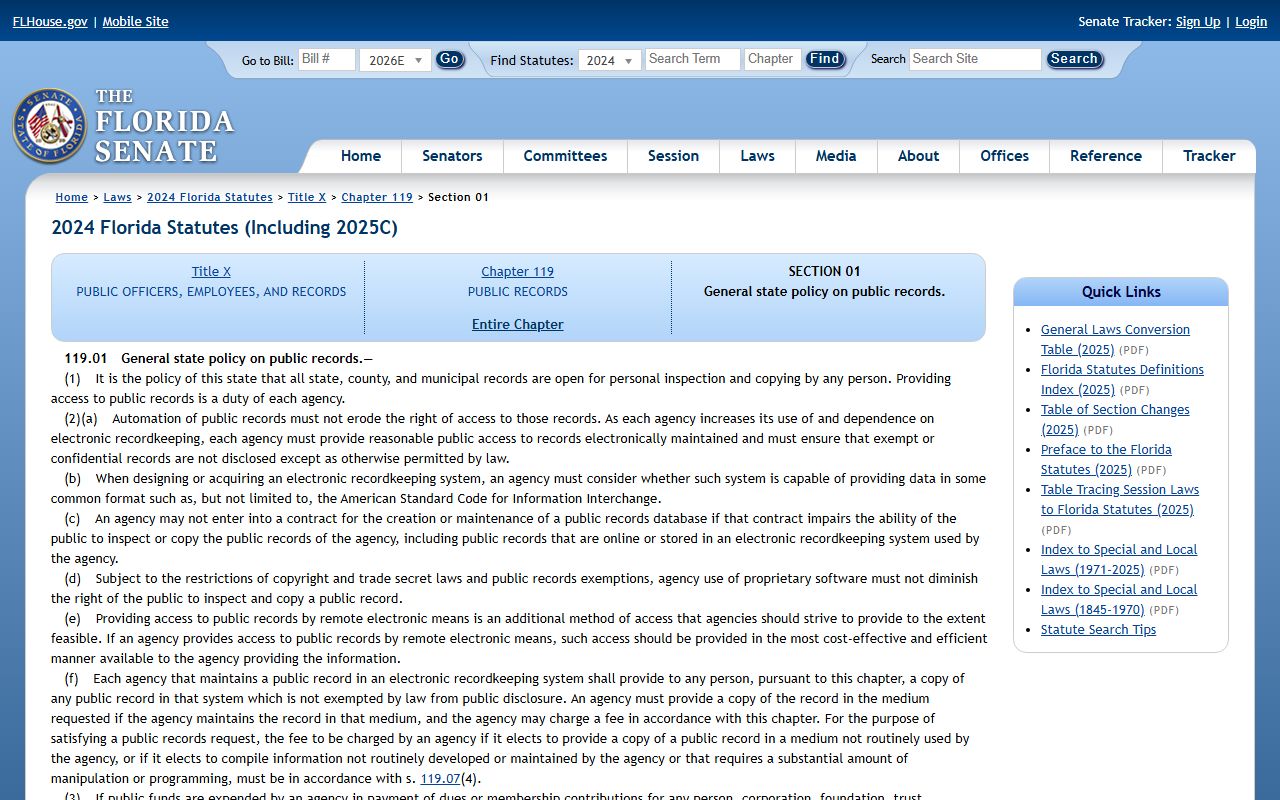
That same chapter sets the rules an agency must follow when it copies or hands over a public record, and the Florida Senate page for § 119.07 spells out the inspection and copy duties that bind Lee County offices.
Records the Lee County Clerk Maintains
The Clerk of Court wears more than one hat in Florida. Clerk Kevin C. Karnes serves as Clerk of the Circuit Court and Comptroller, county recorder, Clerk to the Board of County Commissioners, county Chief Financial Officer, Treasurer, and Auditor. That mix means the office holds a wide set of public records, not just court files. The office manages close to $2 billion in public funds each year and audits more than $1 billion in county spending.
- Court case files for civil, criminal, family, probate, guardianship, juvenile, mental health, traffic, small claims, and ordinance matters.
- Official records: deeds, mortgages, liens, judgments, releases, plats, certificates of title, lis pendens, and death certificates filed for record.
- Marriage licenses and marriage records issued by the Clerk under § 741.01.
- Board of County Commissioners minutes, agendas, resolutions, and budget files.
- Business records that are filed locally, such as fictitious name notices and certain liens against businesses.
- Military discharges (DD-214) filed for safekeeping.
- County financial reports, audits, and tourist tax filings.
The Clerk's role as county recorder traces to Florida Statutes § 28.222. The recorder duty is what makes the Clerk the place to find deeds and recorded liens, not the tax collector or the property appraiser. The Clerk also runs property fraud alerts that flag new filings tied to a name. That helps owners spot fake deeds early.
Court Records vs Official Records
One of the most common Lee County public records mix-ups is the gap between court records and official records. They are not the same file. Each lives in its own portal, follows its own access rule, and has its own copy charge.
| Feature | Court Records | Official Records |
|---|---|---|
| Where to search | matrix.leeclerk.org | or.leeclerk.org |
| What is inside | Case files, dockets, motions, orders, judgments, hearings | Deeds, mortgages, liens, judgments recorded by book and page, plats |
| Governing rule | Rule 2.420 and Access Security Matrix | Chapter 119 and § 28.222 |
| Request method | VOR request in MATRIX or Records Request System | Records Request System; E-Certify for certified copies |
| Certified copy | $1 per page plus $2 certification, or $8 e-certified | $1 per page plus $2 certification, or $8 e-certified |
Court files cover things a judge sees. Official records cover things filed with the county recorder. A divorce decree may live in both. The case file sits in MATRIX, while a certified copy filed with the recorder may also appear in Landmark. Knowing which side holds the file you need saves time and money.
Public Records Request Options
The Clerk's online tools group every common task on one page. Pick the tool that fits the file. Self-service tools cost nothing for plain viewing, while certified copies and e-certified copies carry a state-set fee.
- Search Court Records: free public search in MATRIX with anonymous, registered, and party access levels.
- Search Official Records: free name, document, book and page, and legal search in Landmark.
- Submit Records Request: the formal route for records not on the portals or for certified copies.
- Track My Records Requests: status checks tied to the tracking number from a prior request.
- Bulk Data Requests: a separate sign-up and purchase channel for large data sets.
- Verify e-Certified Document: a check tool for the digital signature and code on a paid e-certified copy.
For court files, the MATRIX search is the first stop. Anonymous users can see many case types, but family, probate, guardianship, juvenile, and mental health cases often need a registered account or party access to view the documents. Some files carry a Viewable on Request flag. That flag tells the Clerk to check the file for confidential or exempt data before release. Party access is requested by email to CRIaccounts@leeclerk.org, by mail to P.O. Box 3207, or in person at the Customer Service Counter on the Justice Center campus.
Fees for Lee County Public Records
Most Lee County public records fees are set by Florida Statutes § 28.24 and the Clerk's local fee schedule. Plain copies of non-court records cost less than certified copies, and e-certified copies cost more because the vendor adds a charge for the secure digital signature. Pay no more than the law allows.
| Item | Amount |
|---|---|
| Plain copy of non-court, non-official public record (per page) | $0.15 |
| Certifying non-court, non-official public records | $2.00 |
| Official record copy (8.5x14 or smaller, per page) | $1.00 |
| Certified copy of Notice of Appeal or court paper (per page where listed) | $1.00 |
| Certified copy certification | $2.00 per certification |
| E-Certified per court document or official record | $8.00 ($2 statutory + $6 vendor) |
| Notarizing documents | $10.00 per instrument |
| Notarizing domestic violence forms | No charge |
| Driving history record (full) | $16.25 |
Special service charges may apply when a request needs a lot of staff time, such as a long span of older files. The agency must tell the requester before doing that work and must base the charge on the actual labor cost. Florida Senate's page for § 119.071 sets the rules around exemptions that may also drive added review time.
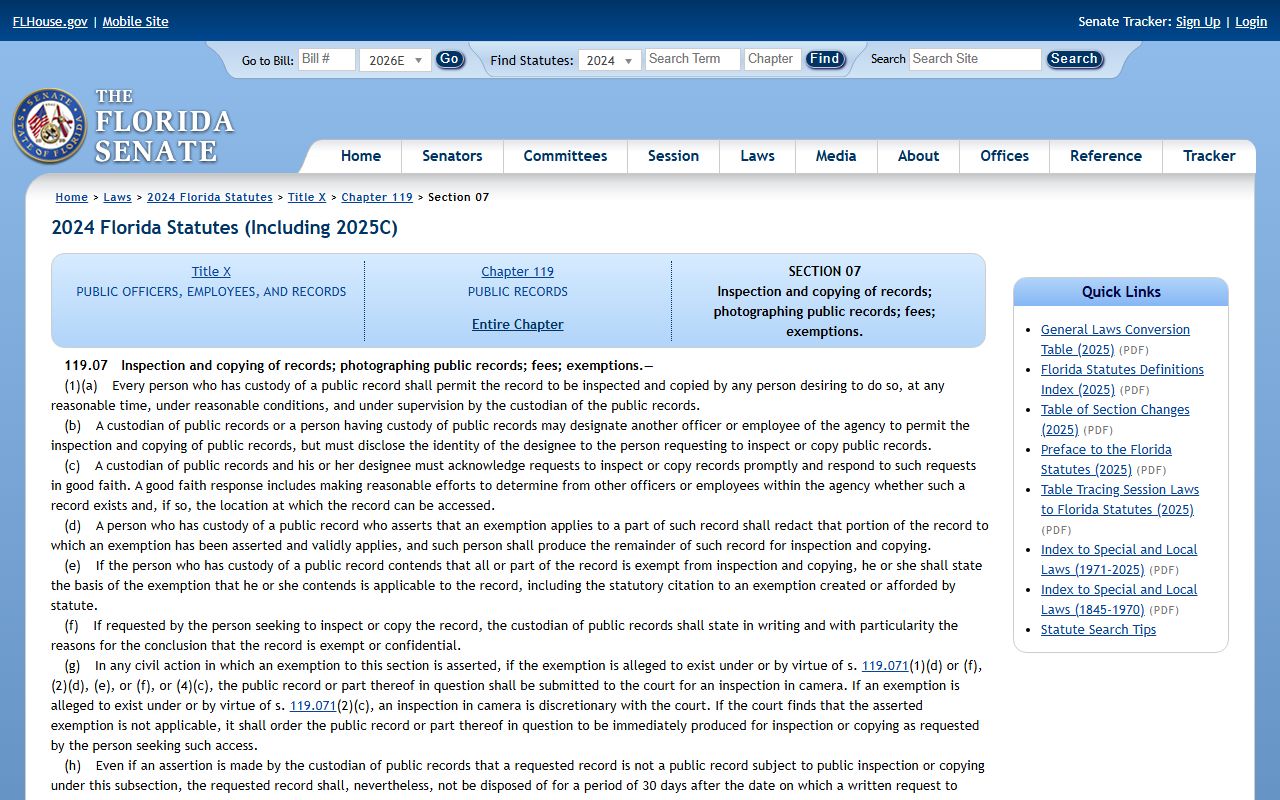
The page above is the lead source for the inspection and copy duties that bind every Lee County office, and it sits right next to the exemption page that drives review labor charges.
Confidential and Exempt Records
Not every Lee County public record is open. Some files are sealed by court order. Others are made confidential by Florida statute. The Clerk has to redact protected data and may withhold whole files in some classes.
- Victim and identity data under § 119.071, including Marsy's Law protections for crime victims.
- Social Security numbers and bank or credit card numbers in court filings and recorded papers, under § 119.0714.
- Juvenile justice records under § 985.04, which the Clerk lists as a case type but limits in public search.
- Adoption records under § 63.162, which are fully sealed except by court order or statute.
- Mental health clinical records under § 394.4615.
- Sealed and expunged criminal records under §§ 943.0585 and 943.059.
- Grand jury materials, which are secret by default under Florida criminal procedure.
For court files, the Florida Rules of General Practice and Judicial Administration spell out the route. Rule 2.420 sets the framework for confidential filings, the notice of confidential information, and the steps for sealing. Rule 2.425 tells filers to keep sensitive numbers and identifiers out of court papers in the first place. Rule 2.430 sets the retention clock that drives why some old files vanish from the public portal after the audit period.
The Florida Senate page for § 119.071 is the master list of general exemptions, and it is worth a read before filing a Lee County public records request that touches victim, law enforcement, or identity data.
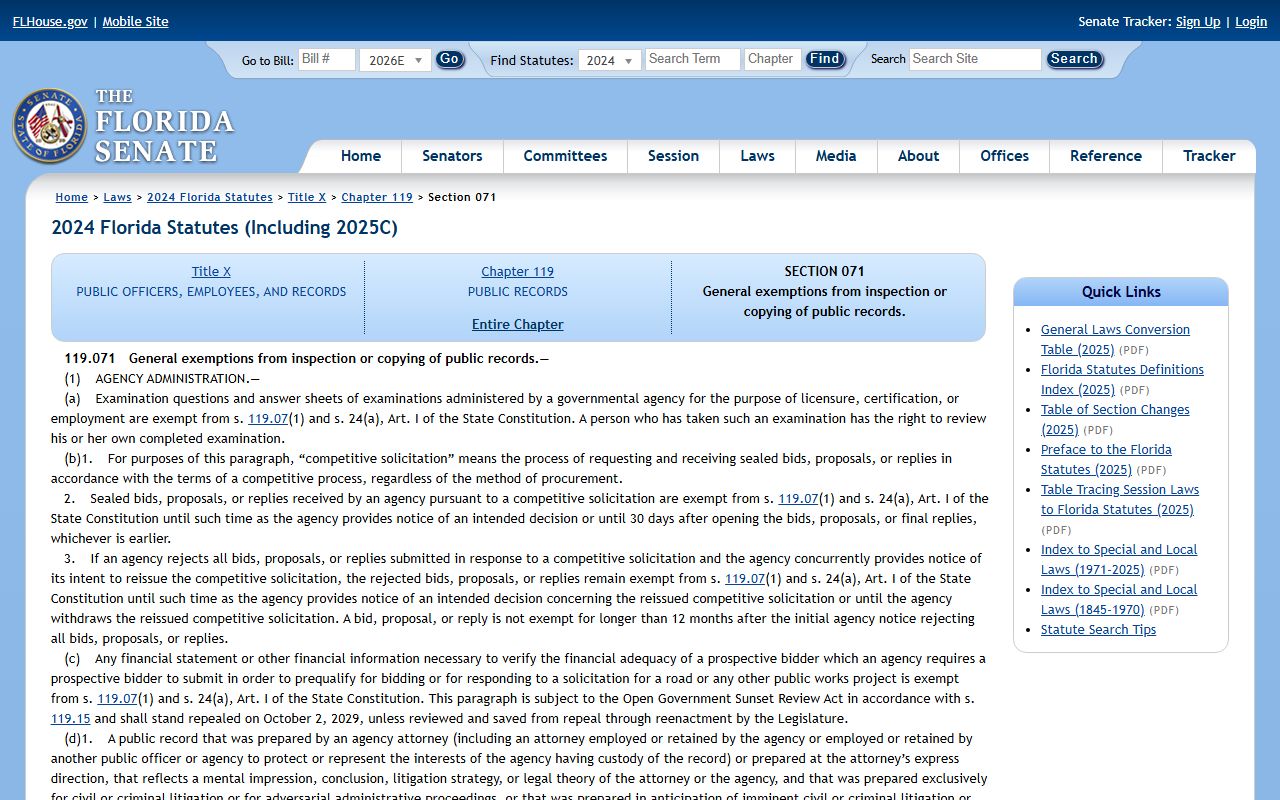
The page lays out the most common reasons a Lee County file may come back partly redacted or fully withheld.
Sheriff and State Attorney Records
Not every Lee County public record sits with the Clerk. Two other custodians hold their own files and run their own request routes.
The Lee County Sheriff's Office is the custodian of arrest reports, jail booking files, incident reports, and 911-related records. Sheriff Carmine Marceno's office runs the booking search as a courtesy tool but tells users that the page is not a substitute for a Chapter 119 public records request. The Sheriff's main non-emergency line is (239) 477-1000. The Downtown Jail intake number is (239) 477-1500. Final court disposition has to be checked in court records, not the Sheriff's booking page.
The Office of the State Attorney, Twentieth Judicial Circuit, is the prosecutor for Lee County. State Attorney Amira D. Fox's office holds case files for prosecutions in the Twentieth Circuit. Requests for prosecution files go through sao20.org, not the Lee Clerk. The Lee County office is at 2000 Main Street, Fort Myers, with phone (239) 533-1000 and email stateattorney@sao20.org. The State Attorney holds a Public Records link on the home page that points to its own request system.
Note: Filed court papers from a State Attorney case still appear in the Clerk's MATRIX system when public, so a full Lee County case picture often means asking both offices.
How to Challenge a Denial or Clarify Access
Florida law gives a requester real teeth when an agency refuses a record without legal cause. The state's open records framework lets a person sue in civil court to force the release of a wrongly withheld file. If a court finds the agency broke the law, the agency may have to pay the requester's attorney fees and court costs. That fee-shift rule is one reason Florida agencies tend to release records fast.
Step one is a clear written request. If the office holds the file back, ask for the legal basis in writing. The agency must point to the statute or rule that justifies the call. If the answer cites § 119.071 or another exemption, read that section before pushing further. Many denials come from a thin description rather than from an actual block on the record.
For court files, the path is different. Court records sit under Rule 2.420, not Chapter 119, and a sealed or VOR file is unblocked through a motion in the case rather than a civil suit against an agency. The Clerk's court records page walks through the VOR review path. For deeper issues, a Florida attorney can file a motion to unseal or to challenge a confidentiality designation under Rule 2.420(d).
Note: A Lee County request that is denied in writing is the cleanest record to take to court, so keep the email or letter that quotes the legal basis.
Bulk Data and Vendor Considerations
Vendors, researchers, and journalists sometimes want broad slices of Lee County public records rather than one file at a time. The Clerk runs a Bulk Data Requests track for that need. The bulk channel uses its own sign-up and purchase process, since pulling a wide set of files needs server capacity, format choices, and a contract that locks in use limits. Pricing is not posted in the public crawl, so the bulk request page is the source for any current quote.
That same warning shapes how bulk users word a contract. The agreement, the email, and the data fields chosen can all become public. Vendors who plan to resell the data should also check Florida's rules on commercial use of public records, since some classes carry separate use limits even when the raw data is open.
For routine one-off pulls of recorded papers, the E-Certify tool and the per-page official record copy fee are far cheaper than a bulk contract. Bulk pricing makes sense when a user needs thousands of files or a daily feed, not for a single deed or a single case file.
Common Questions
Three quick answers cover the most common Lee County public records questions. The FAQ page has the full list.
Can anyone file a Lee County public records request? Yes. Florida law gives any person, in or out of state, the right to inspect or copy a public record, with no need to give a reason or show ID. Some narrow exemptions apply, such as the rules that limit who can see a victim's address.
How long does the Lee Clerk take to respond? Florida law does not set a hard deadline. The duty is a fair and reasonable time to find, redact, and copy the file. Simple plain copies often come back within days. Files that need legal review or that span years take longer.
Are marriage and divorce records public in Lee County? Marriage licenses are open public records. Divorce dockets are public, with limits on sensitive data under Rule 2.420. The marriage and divorce records page covers the access rules in depth. For estate matters, see the probate records page.