
How to Search Lee County Criminal Records
Two main tools cover most Lee County criminal record needs. The first is the Lee County Sheriff's Office arrest and booking search. The second is the Clerk's case search portal at matrix.leeclerk.org, called MATRIX. MATRIX lists Adult Felony, Misdemeanor, CriminalTraffic, County Ordinance, Municipal Ordinance, Detention Hearing, and Appeals as case-type filters. The Sheriff site shows recent bookings and recent releases. MATRIX shows what the court did with the case.
The Sheriff search form accepts a first name, middle name, last name, date of birth, booking number, custody status, and date ranges for booking or release. Results return name, DOB, booking number, and status. Each result links to a booking detail page with charges, bond, arresting agency, court location, and a hearing date if one is set.
- Open the Sheriff booking search. Click "Recent Bookings" to see the latest intakes, or type a last name and click Search.
- Open the booking detail page. Note the case number, court location, bond, and arresting agency. Lee County misdemeanor case numbers often look like 26MM022093.
- Take that case number to MATRIX. Pick the matching case type. Enter the case number or party name. Use MM/DD/YYYY for date fields.
- Open the case docket. Look for the charging document, plea, judgment, and sentence. Some images are Viewable on Request and need Clerk review.
- For a statewide record, request a Florida criminal history from the Florida Department of Law Enforcement for a small fee.
For last-name-only searches in MATRIX, the portal asks for an asterisk in the First Name box. Case searches cap at 500 hits. Hearing searches cap at 200.
Felony vs Misdemeanor Records in Lee County
Florida splits criminal cases between two trial courts. Felonies go to the Circuit Court. Misdemeanors and most ordinance or criminal traffic cases go to County Court. Both are searched through MATRIX, but the filing court changes the case number prefix, the judge, and the fee schedule. The split also matters for sentencing limits.
| Felony | Misdemeanor | |
|---|---|---|
| Trial Court | Circuit Court (Twentieth Judicial Circuit) | County Court |
| Max Penalty | State prison time, large fines | Up to 1 year in county jail |
| Examples | Burglary, grand theft, aggravated battery, drug trafficking | DUI first offense, petit theft, simple battery, disorderly conduct |
| MATRIX Case Type | Adult - Felony | Misdemeanor, CriminalTraffic, County Ordinance |
| Where to Search | MATRIX + Sheriff booking | MATRIX + Sheriff booking |
A few cases shift between courts. Felony charges that get reduced through plea may end up listed as misdemeanors at sentencing. Ordinance and municipal ordinance matters appear as their own case types in MATRIX. For traffic overlap, see Lee County traffic court records.
Arrest Records vs Court Disposition Records
An arrest record and a court record are not the same file. The Sheriff makes the arrest record at the jail. The Clerk makes the court record when the State Attorney files a charge. The Sheriff arrest search page warns this directly. The database reflects what happened at the time of arrest. It is not the final disposition. For the final outcome, the Sheriff page tells users to go to leeclerk.org.
That gap matters. A booking can show three charges, and the court file can end up showing one. Charges get dropped. New charges get added. The State Attorney can decline to file at all. The booking record never changes after intake. The court record updates every time the judge signs something.
The lead-in image below shows the Sheriff's arrest search tool. The form takes name, DOB, booking number, and date range fields.
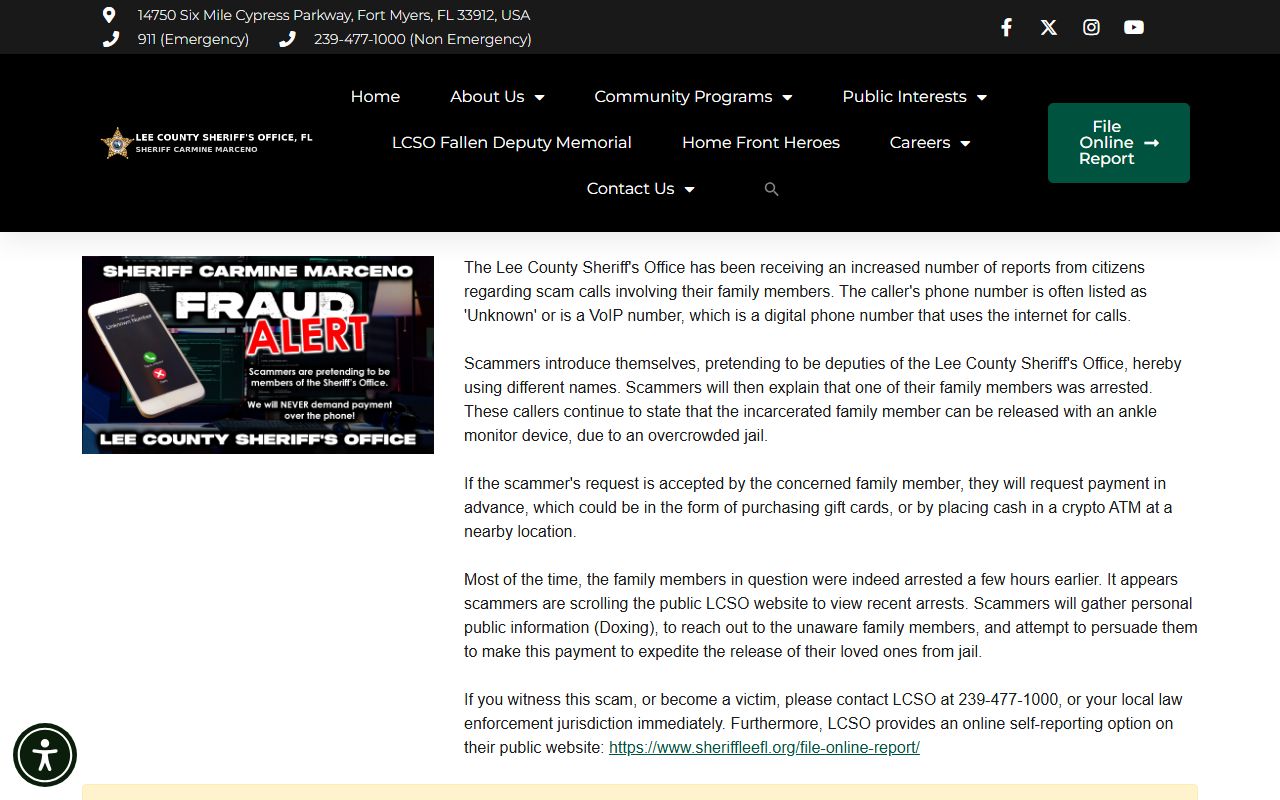
The form ties into a public JSON feed. The booking detail page pulls charges, bond, and hearing data for each booking number. Final case status still needs a Clerk lookup.
Booking and Charge Fields
The Lee Sheriff booking record holds two sets of fields. One set is about the person. The other is about each charge. The fields below come straight from the public booking feed.
| Field | What It Shows |
|---|---|
| bookingNumber | Numeric ID for the intake event. |
| bookingDate | Date and time of jail intake. |
| releaseDate | Date and time the person left custody. |
| surName / givenName / middleName | Last, first, and middle name on the booking. |
| birthDate | Date of birth on file. |
| race / sex / height / weight / hair | Physical descriptors at intake. |
| image | Booking photo (mugshot). |
| offenseDescription | Plain-language name of the charge. |
| offenseCode / section | Florida Statute reference for the charge. |
| bondAmount / bondTypeName | Bond set, or "No Bond" if held. |
| caseNumber | Court case number, like 26MM022093. |
| arrestingAgencyName | Police or sheriff agency that made the arrest. |
| courtLocation | Court that will hear the charge, often "County Court." |
| hearingDate | Next scheduled court date. |
The arresting agency line can read "LEE COUNTY SHERIFFS OFFICE" or a city police department. The mugshot field is raw image data. A booking can list one charge or many. Each one carries its own bond and disposition entry.
Charges vs Convictions
A charge is an accusation. A conviction is the end of the case. Florida law also lets a judge withhold adjudication. That means a person can plead guilty or no contest, get probation or a fine, and still not be legally convicted. Withhold adjudication shows up in court records but is not the same as a conviction for many purposes. The glossary in court records covers more terms.
| Charge | Conviction | |
|---|---|---|
| Stage | Accusation, before trial or plea | Verdict, plea, or court finding |
| Burden of Proof | Probable cause | Beyond reasonable doubt |
| Filed By | State Attorney (information) or grand jury (indictment) | Entered by the trial judge |
| Public Record | Yes, unless sealed | Yes, unless sealed or expunged |
| Florida Twist | Can be dropped or "no-filed" | Adjudication can be withheld |
That distinction matters for background checks. A booking record can show a charge that the State Attorney later dropped. The arrest still happened. The conviction did not. Both facts can be true at once.
Sealed vs Expunged Records
Florida treats sealing and expunction as two different remedies. Both start with a Florida Department of Law Enforcement certificate of eligibility. Both then need a court order from the same court that handled the case. The rules sit in Florida Statutes § 943.0585 for expunction, § 943.059 for sealing, and § 943.0584 for the list of offenses that can never be sealed or expunged.
| Sealed | Expunged | |
|---|---|---|
| What Happens | Record hidden from public view | Most agency copies destroyed; FDLE keeps a confidential copy |
| Statute | Fla. Stat. § 943.059 | Fla. Stat. § 943.0585 |
| Law Enforcement Access | Limited, available with court order | Very limited, narrow statutory exceptions |
| Lifetime Limit | One per person | One per person |
| Ineligible Offenses | Listed in § 943.0584 | Listed in § 943.0584 |
A prior conviction blocks both. So does a pending charge. FDLE will deny the certificate if any of the statutory bars apply. The lead-in image below shows the official FDLE certificate of eligibility instructions.
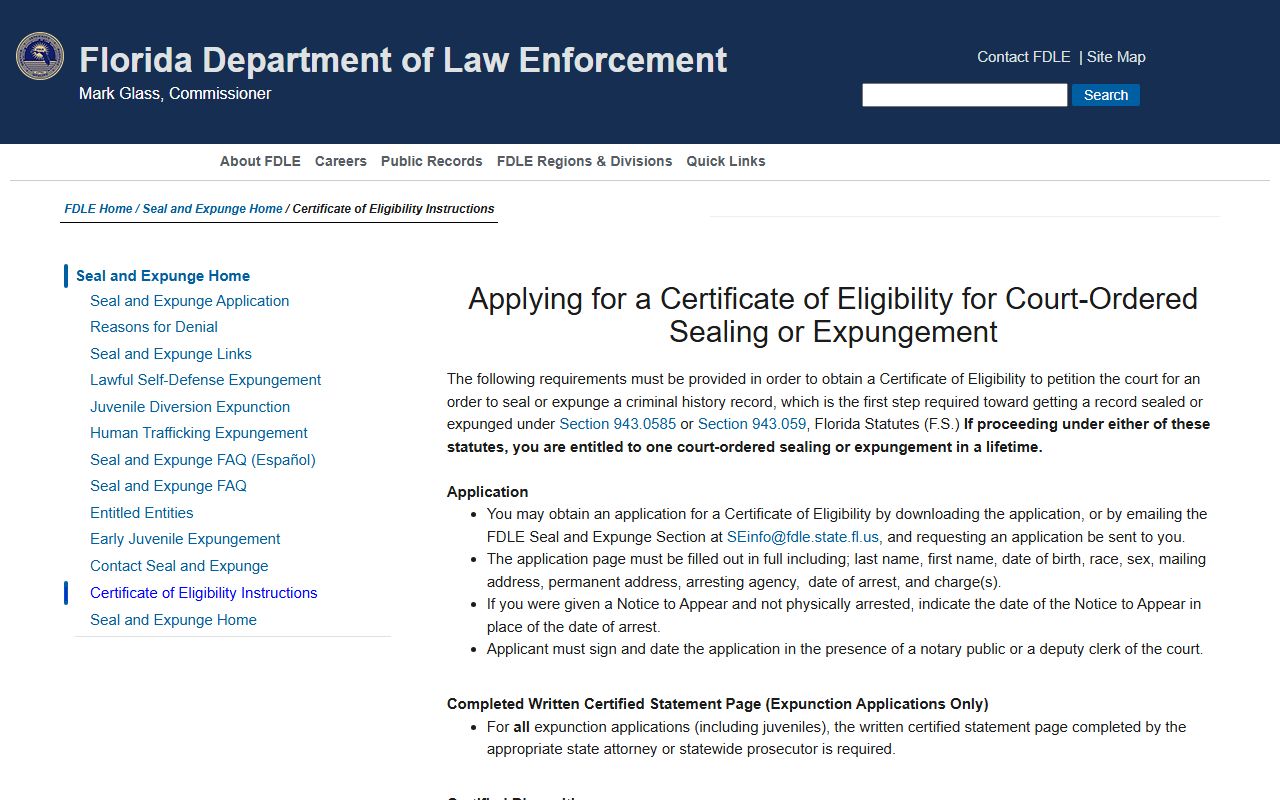
The instructions cover the forms, the fingerprint card, the certified disposition, and the state attorney certification step. Without all four, FDLE will not issue the certificate.
How to Seal or Expunge a Lee County Criminal Record
Sealing or expunging a Lee County case is not automatic. Even if the charges were dropped, the file stays public until a judge orders otherwise. The process runs through FDLE first, then through the Twentieth Judicial Circuit court that handled the case.
- Confirm the offense is not on the § 943.0584 ineligible list. Prior sealings or expunctions also block a new petition.
- Order a certified copy of the final disposition from the Clerk of Court. Some cases need a State Attorney certification on the FDLE form.
- Complete the FDLE application packet. Get fingerprints taken by a Florida law enforcement agency on the FDLE card.
- Mail the packet to FDLE with the filing fee. Wait for the certificate of eligibility decision. This step can take months.
- If approved, file a petition in the court that handled the case. Serve the State Attorney, the arresting agency, and FDLE.
- Attend the hearing if the judge sets one. The judge signs an order to seal or expunge, or denies the petition.
- The Clerk and FDLE process the order. The Sheriff and arresting agency act on it under § 943.0585 or § 943.059.
Common denial reasons are missing certified disposition, an unresolved charge somewhere else in Florida, a disqualifying prior, or service that did not reach every required agency.
State Attorney and Public Defender
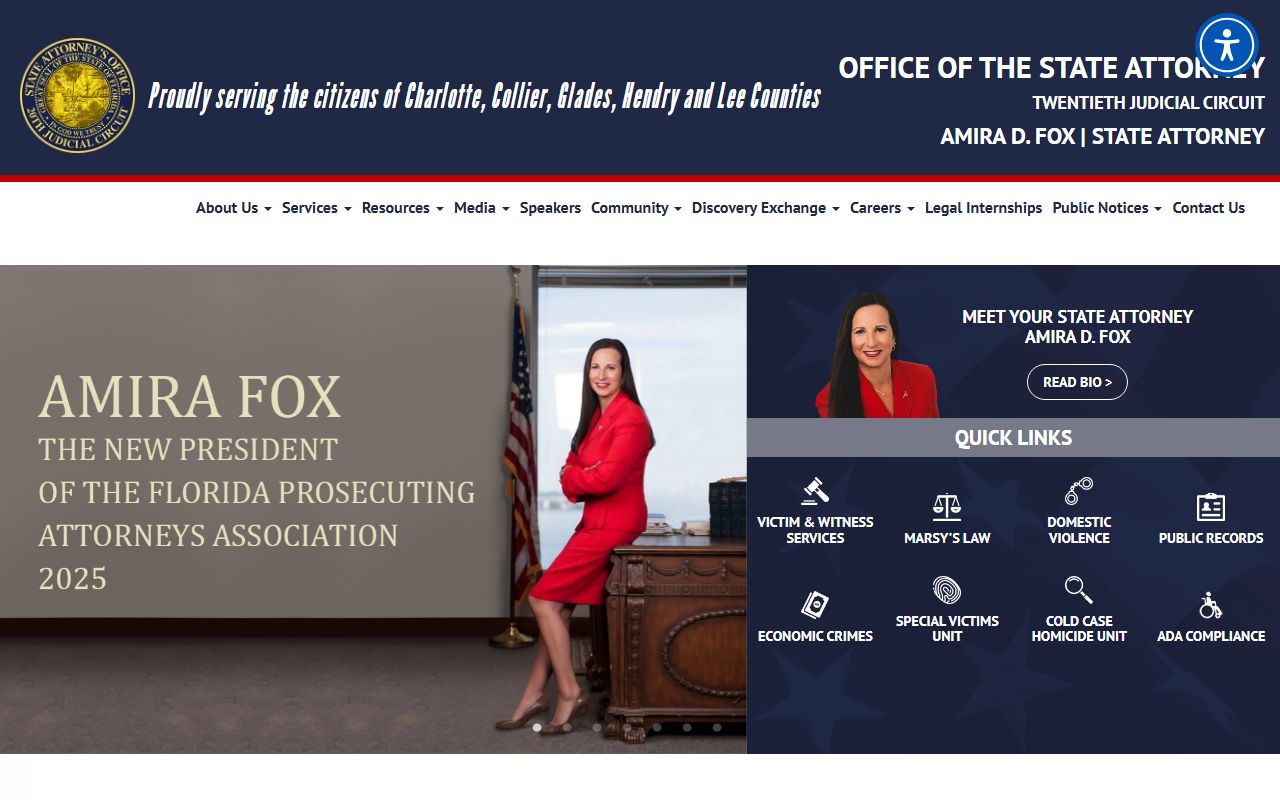
Florida calls the prosecutor the State Attorney. Lee County falls under the Office of the State Attorney for the Twentieth Judicial Circuit. The official site is sao20.org. The State Attorney is Amira D. Fox. The Lee County office is at 2000 Main St, Fort Myers, FL 33901, phone (239) 533-1000. The same office serves Charlotte, Collier, Glades, Hendry, and Lee counties.
The State Attorney reviews each arrest, decides whether to file an information, and prosecutes the case in Circuit or County Court. The office also handles victim services under Marsy's Law, an Economic Crimes unit, a Special Victims Unit, and a Cold Case Homicide Unit. Public records requests for State Attorney files go through that office, not the Clerk. Court filings still show up in the Clerk's MATRIX system.
The Public Defender for the Twentieth Judicial Circuit covers the same five counties. Indigent defendants ask the court to appoint counsel at first appearance. The Public Defender takes most cases. When a conflict comes up, the court appoints conflict counsel instead.
Federal Criminal Records
Federal crimes in Lee County route to the U.S. District Court for the Middle District of Florida, not the Twentieth Judicial Circuit. The U.S. Attorney's Office for the Middle District prosecutes those cases. Federal filings, dockets, and orders sit in PACER, not MATRIX. The Lee Clerk does not hold federal criminal records.
To search a federal Lee County case, set up a PACER account. Use the Case Locator or the Middle District CM/ECF system. The Middle District site is flmd.uscourts.gov. Free opinion mirrors live at CourtListener, but PACER is the official docket. For a federal inmate, check the BOP Inmate Locator at bop.gov.
Public Access and Statutes
Florida is access-forward by default. Article I, § 24 of the Florida Constitution gives the public a right to inspect records. Florida Statutes Chapter 119 covers agency records. Judicial branch records run on a separate track under Florida Rule of General Practice and Judicial Administration 2.420, plus the Supreme Court's Access Security Matrix. Lee Clerk uses both systems, depending on the record type.
Criminal records have their own carve-outs. Juvenile delinquency records are restricted under Fla. Stat. § 985.04. Victim and identity exemptions sit in § 119.071. Adoption records are confidential under § 63.162. Mental health clinical records fall under § 394.4615. The MATRIX public search notice warns that juvenile and mental health case searches will not return full results.
Florida Statutes that govern Lee County criminal records:
- Fla. Stat. § 119.071 exemptions for victim, identity, and law enforcement information.
- Fla. Stat. § 943.0584 lists offenses that can never be sealed or expunged.
- Fla. Stat. § 901.02 covers arrest warrants and probable cause.
- Fla. Stat. § 933.07 covers search warrant issuance.
Note: arrest warrants and search warrants are different orders, and details on search warrants often stay sealed during an active investigation. See Lee County warrant records for more.
Common Questions
A few questions come up over and over about Lee County criminal records. The full set lives on the FAQ page.
Can I find a mugshot from a recent Lee County arrest? Yes. The Sheriff booking search shows booking photos in the public feed. The image field returns the mugshot for each booking record. The image stays in the system after release.
Does an arrest stay public if the case was dropped? The arrest record stays at the Sheriff. The court case shows the no-file or dismissal at the Clerk. The booking is not removed on its own. A sealing or expunction petition under § 943.059 or § 943.0585 is the way to limit public access. More on the FAQ page.
Where do I get a certified Lee County criminal record? The Clerk of Court sells e-certified court records through matrix.LeeClerk.org. The Sheriff handles arrest report copies. FDLE sells a full Florida criminal history for a small fee.